Why Shotcrete Is More Than Sprayed Concrete
Shotcrete is often described as concrete sprayed onto a surface. That explanation is correct, but incomplete.
The process delivers concrete or mortar through a hose and projects it pneumatically at high velocity. Impact against the receiving surface places and compacts the material at the same time. This allows concrete to adhere to vertical walls, tunnel crowns, rock faces, curved shells, and other areas where conventional casting would require extensive formwork. ACI describes shotcrete as a method that can create strong adhesion to many substrates while reducing the need for conventional forms.
Its real value comes from combining several operations:
- Material transportation
- Placement
- Compaction
- Surface coverage
- Early ground support
These operations occur continuously at the nozzle.
Our review at Shandong Jianbang Fiber shows that shotcrete performance cannot be separated from the application process. A well-designed concrete mixture may still fail if the receiving surface is dirty, the nozzle angle is wrong, rebound becomes trapped, or fibers are lost during spraying.
The opposite is also true. Skilled spraying cannot compensate for unstable concrete, incompatible accelerators, poor aggregate grading, or an unsuitable fiber.
Shotcrete must therefore be treated as a complete system.
A Short History Of Shotcrete Technology
Early shotcrete developed from pneumatic cement and mortar spraying. The source material records its use in American mining and civil engineering during the early twentieth century, followed by the development of rotary and twin-chamber spraying machines in Europe.
Its role expanded significantly with the development of modern tunnelling methods. Instead of relying only on rigid supports, engineers began using timely surface support to control rock deformation and allow part of the surrounding ground to carry itself.
China introduced shotcrete support into mining and tunnel construction during the 1960s. It later spread to railway tunnels, hydropower caverns, urban underground works, slope engineering, structural repair, and protective construction.
Modern progress has focused on mechanized wet spraying, alkali-free accelerators, silica fume, robotic booms, improved pumps, steel fibers, macro synthetic fibers, and performance-based testing. ACI’s current shotcrete guidance covers dry and wet processes, application procedures, crew responsibilities, equipment, preconstruction trials, material testing, and acceptance of finished work.
How Shotcrete Supports Rock
Freshly excavated rock is rarely completely stable.
Joints may open after excavation. Loose fragments can fall. Moisture and air can accelerate weathering. Local deformation may continue as stress redistributes around the opening.
A timely shotcrete layer covers the exposed surface and begins working with the rock mass. It limits loosening, connects smaller blocks, and distributes local forces toward a broader area.
In underground support, several effects work together:
Early restraint: Applying shotcrete soon after excavation limits excessive movement before the ground loses too much strength.
Surface integration: The layer joins irregular rock blocks into a more continuous support surface.
Bond: Adhesion between the sprayed layer and rock helps transfer local stress.
Controlled deformation: A properly designed support system allows limited ground movement without immediate collapse.
Load distribution: Around bolts, anchors, mesh, and lattice girders, shotcrete spreads concentrated forces across a wider area.
Pages 13–21 of the source material illustrate rock-support mechanisms, ground-reaction behaviour, punching around bolt heads, and the pressure distribution created by a sprayed layer.
Shotcrete is not a substitute for geological analysis. Drainage, rock bolts, anchors, steel arches, mesh, excavation sequence, and support timing may still be necessary. FHWA also notes that shotcrete used on slopes must be coordinated with drainage and ground-reinforcement requirements.
Where Shotcrete Is Used
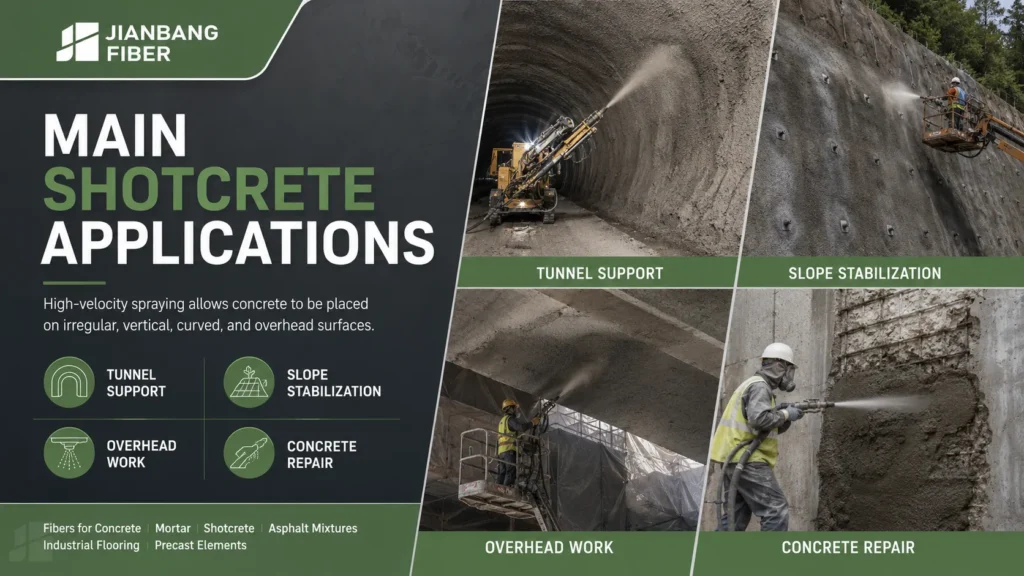
Underground Construction
Road tunnels, railway tunnels, metro stations, mines, shafts, caverns, and hydropower projects are among its most important applications.
A sprayed layer can provide immediate initial support. Depending on the design, it may later become part of a permanent lining system.
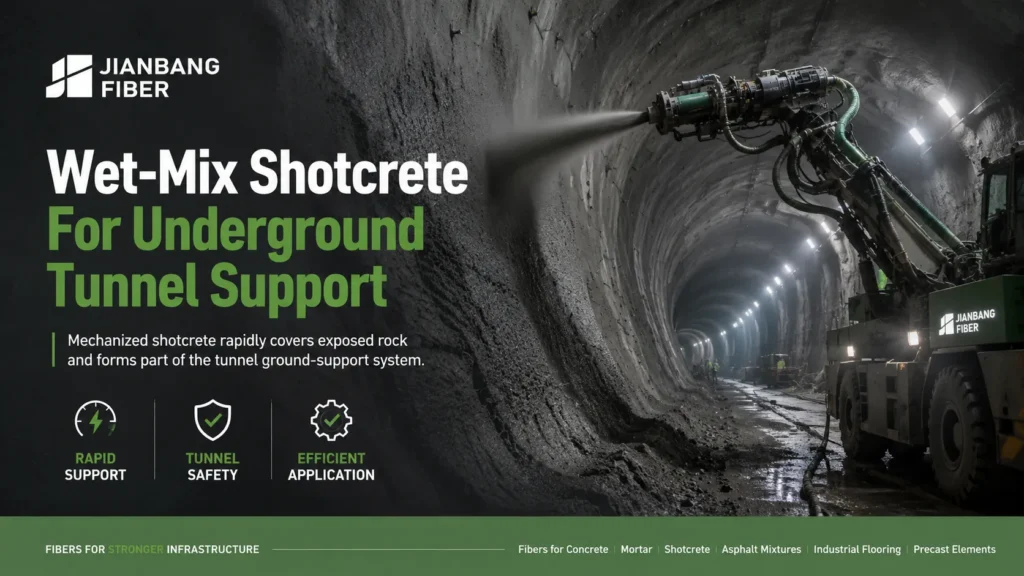
Large tunnel projects increasingly use robotic wet-mix spraying. Higher production rates and remote operation help crews cover large areas while reducing time spent close to newly excavated ground.
Rock Slopes
Shotcrete protects exposed rock from erosion, weathering, raveling, and the loosening of small blocks. Anchors and drainage systems are often added when the slope requires more than surface protection.
FHWA identifies shotcrete as a practical slope treatment, but also warns that a continuous sprayed surface may restrict drainage unless drainage measures are included.
Structural Repair
Deteriorated concrete can be removed and rebuilt without erecting conventional two-sided formwork.
Common repair targets include:
- Bridge substructures
- Tunnels and culverts
- Retaining walls
- Dams and hydraulic structures
- Industrial buildings
- Marine facilities
- Columns, beams, and walls
Bond performance is critical. Loose concrete, dust, oil, corrosion products, standing water, and poor surface roughness can all weaken the repair interface.
Soil-Nail Walls And Excavation Support
Shotcrete forms the facing of many soil-nail walls. The facing receives forces from nail heads, limits local deformation, and protects the excavated surface.
The required thickness, reinforcement, joint arrangement, drainage, and anchor details must be calculated as part of the retaining system.
Thin Shells And Complex Geometry
Pools, domes, curved walls, sculpted rock finishes, tanks, and irregular architectural elements benefit from one-sided placement.
Instead of enclosing the concrete between two forms, crews build the required profile directly against guides, reinforcement, or a receiving surface.
Refractory And High-Temperature Repair
Specialized dry or wet sprayed materials are used in kilns, furnaces, chimneys, and industrial vessels.
These mixtures differ from ordinary construction shotcrete. Refractory binders, heat-resistant aggregates, specialized accelerators, and suitable fiber types must match the operating temperature.
Dry-Mix Shotcrete Vs Wet-Mix Shotcrete
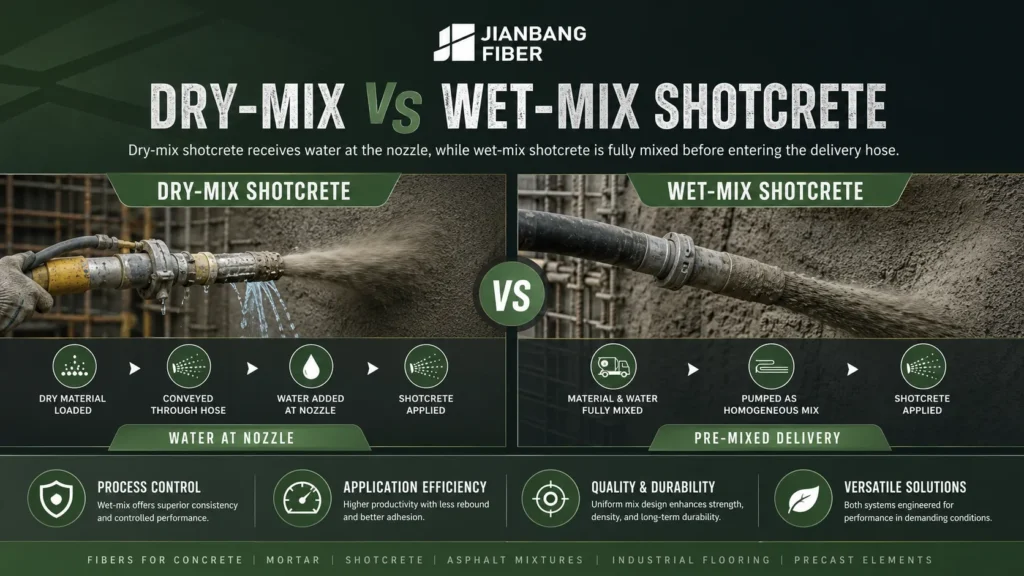
The distinction depends on where water enters the process.
In dry-mix shotcrete, cement and aggregate travel pneumatically through the hose in a dry or slightly damp condition. Water is introduced near the nozzle.
In wet-mix shotcrete, all ingredients—including water—are mixed before entering the delivery hose. A concrete pump transports the mixture, while compressed air at the nozzle provides the final acceleration.
| Factor | Dry-Mix Shotcrete | Wet-Mix Shotcrete |
|---|---|---|
| Water addition | At or near the nozzle | During batching |
| Delivery | Pneumatic transport | Usually concrete pumping |
| Typical production | Lower and more intermittent | Higher and more continuous |
| Dust | Generally higher | Generally lower |
| Rebound | Often higher | Often lower |
| Water control | Depends strongly on nozzle operator | Controlled during batching |
| Equipment | Compact and mobile | Larger integrated system |
| Long interruptions | Relatively manageable | Hose cleaning may be necessary |
| Robotic application | Less common | Common in large tunnels |
| Fiber integration | Possible but more difficult to control | Easier to batch and monitor |
Why Contractors Still Choose Dry Mix
Dry-mix equipment is useful where the work stops frequently or where only a small amount of material is needed at one time.
Because water has not yet been added throughout the hose, material can be transported over long distances and the operation can pause with less risk of wet concrete setting inside the line.
The nozzle operator may also adjust water according to changing surface conditions.
These advantages suit:
- Local concrete repair
- Small mine headings
- Remote slope work
- Refractory construction
- Intermittent maintenance
- Difficult-access areas
The trade-off is stronger dependence on operator technique. Too little water creates dust, poor hydration, weak bonding, and high rebound. Too much water causes sloughing, sagging, higher shrinkage, and lower strength.
Why Wet Mix Dominates Large Projects
Wet-mix systems provide controlled batching and more consistent water content.
They also integrate well with:
- Silica fume
- High-range water reducers
- Alkali-free accelerators
- Steel fibers
- Macro synthetic fibers
- Robotic spraying equipment
Higher production makes wet mix suitable for large tunnels, metro works, caverns, mines, and continuous linings.
A stable wet mix should remain pumpable without segregation. At the nozzle, compressed air must provide enough velocity for compaction and adhesion.
The process is not automatically low-rebound or high-quality. Poor pumpability, unstable accelerator dosing, wrong air pressure, excessive nozzle distance, and bad spraying angles can still create serious defects.
Water-Cement Ratio And Mix Stability
The source material presents a water-cement ratio of approximately 0.40–0.45 as a practical reference for some traditional dry-mix applications. It also explains that excessive water produces sagging, slipping, and cracking, whereas insufficient water creates dry patches, dust, and excessive rebound.
That range should not be treated as a universal modern specification.
Wet-mix shotcrete may contain silica fume, supplementary cementitious materials, high-range water reducers, fibers, and accelerators. These components change rheology and water demand.
A successful mixture needs the correct balance among:
- Pumpability
- Cohesion
- Nozzle acceleration
- Layer build-up
- Low rebound
- Early setting
- Later-age strength
- Shrinkage control
- Durability
Adding water on site to solve pumping problems may weaken the hardened layer. Mix adjustment should focus first on particle grading, admixture compatibility, paste volume, temperature, and mixing sequence.
Silica Fume And Accelerators
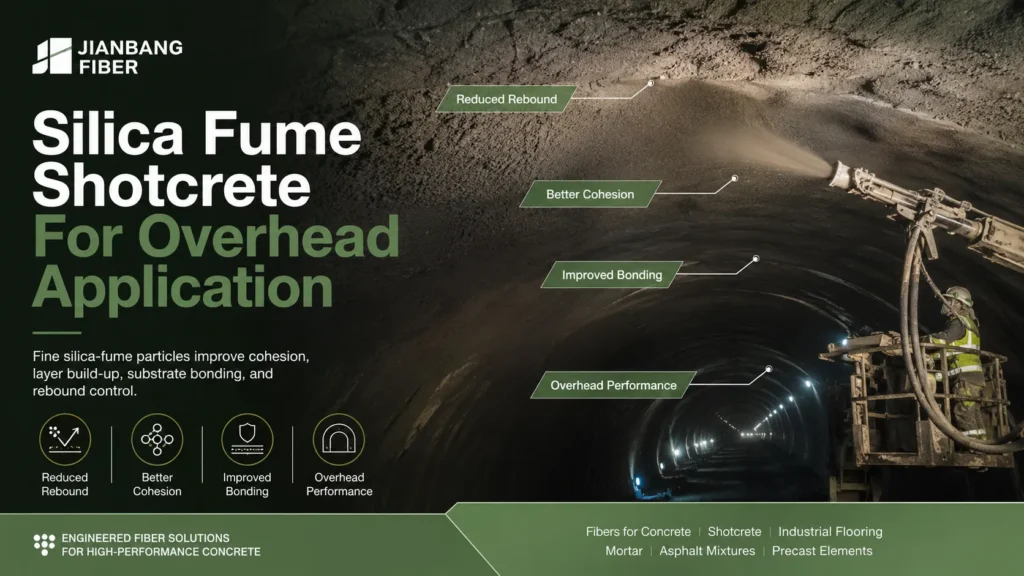
Silica fume does much more than increase compressive strength.
Its extremely fine particles improve the cohesion of fresh shotcrete. A stable mix is less likely to separate during pumping and spraying. On tunnel crowns and other overhead areas, better cohesion allows the layer to build thickness with less sagging.
Lower rebound is another practical benefit. Less material falls to the ground, so the applied mixture stays closer to the intended composition. Bonding to rock, existing concrete, and earlier sprayed layers may also improve.
The Silica Fume Association reports that silica-fume shotcrete supports thicker overhead lifts, reduces rebound substantially, and develops stronger bonding between the material and its substrate or previous layers.
These benefits can be summarized without repeating identical sentence structures:
- More stable pumping: Fine particles increase cohesion and reduce segregation.
- Improved overhead build-up: The fresh layer holds its shape more effectively.
- Lower material loss: Reduced rebound improves efficiency and site cleanliness.
- Denser hardened material: Better particle packing supports lower permeability.
- Stronger interfaces: Bonding to rock, repair substrates, and earlier layers can improve.
The source material discusses silica-fume contents around 5–10% of cement mass in historical or project-specific examples. Final dosage should be established through laboratory trials and full-scale spraying.
Accelerators serve a different purpose. They shorten setting time and allow fresh shotcrete to remain on vertical or overhead surfaces while gaining early support capacity.
Selection should consider more than setting speed. Cement chemistry, accelerator dosage, temperature, later strength, shrinkage, rebound, durability, and worker exposure all matter.
Changing the cement source may change accelerator demand. Compatibility testing should therefore be repeated when key materials change.
What Fiber-Reinforced Shotcrete Does
Plain shotcrete may develop good compressive strength but still lose load capacity rapidly after cracking.
Fibers change that response.
When cracks begin to open, fibers crossing the crack transfer tensile stress between both sides. Energy is consumed through pull-out, deformation, bond friction, or fiber rupture. Instead of separating immediately, the sprayed layer retains part of its load capacity.
ACI’s guide to fiber-reinforced shotcrete focuses primarily on steel macrofibers and synthetic macrofibers. It covers mixture adjustment, batching, equipment, application, and the main engineering uses of both systems.
Fiber reinforcement is especially valuable in:
- Tunnel initial support
- Permanent sprayed linings
- Mines and caverns
- Rock slopes
- Soil-nail facings
- High-impact structures
- Repair layers
- Areas where mesh installation is difficult
Fibers do not automatically replace all bars, anchors, bolts, lattice girders, or structural reinforcement. Their design role must be defined by the engineer.
Steel Fiber-Reinforced Shotcrete
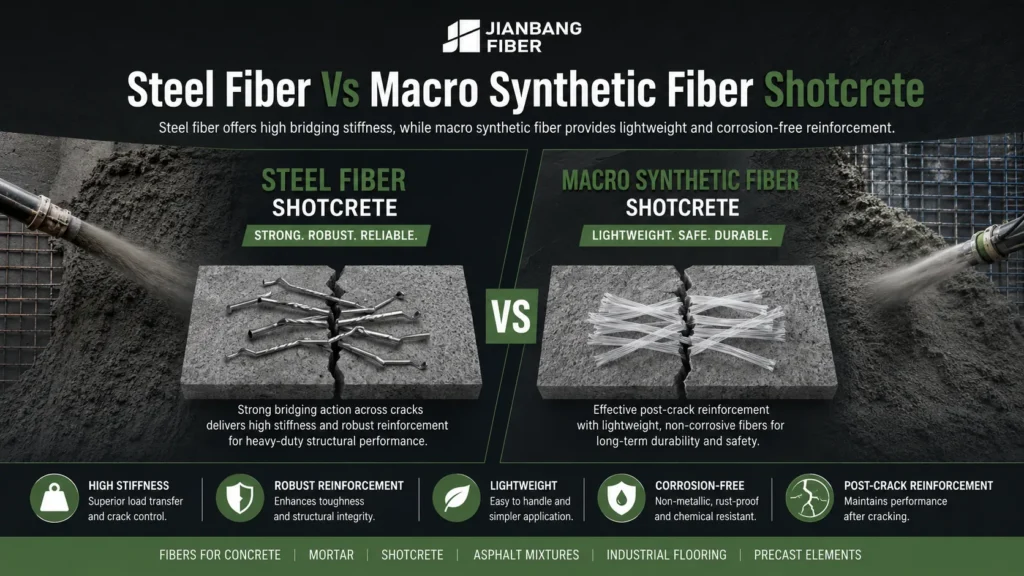
Steel fibers have high tensile strength and high elastic modulus. Their stiffness allows them to resist crack opening from an early stage.
Hooked ends, deformations, waves, or surface roughness improve mechanical anchorage in the cement matrix.
The source material describes traditional fibers with diameters near 0.25–0.40 mm, lengths around 20–30 mm, and aspect ratios around 60–100. It also gives historical dosage examples of 80–100 kg/m³. These values provide technical background but should not be copied directly into a new project specification.
In properly designed shotcrete, steel fibers contribute to:
- Higher flexural toughness
- Stronger residual load capacity
- Better resistance to impact
- Slower fatigue-crack growth
- More distributed cracking
- Reduced risk of local separation
- Greater integrity after the first crack
The wording matters here. Steel fiber does not simply “increase everything.” Its strongest contribution usually appears after the matrix begins to crack.
Fiber retention must also be considered. Steel fibers may rebound differently from mortar and aggregate. The dosage added at the batching plant may therefore exceed the dosage retained in the finished layer.
Macro Synthetic Fiber-Reinforced Shotcrete
Macro synthetic fibers are engineered polymer fibers designed to provide post-crack reinforcement.
Their density is much lower than that of steel. Consequently, comparing products only by kilograms per cubic metre is misleading. A lower mass of synthetic fiber may represent a large number or volume of individual fibers, but its modulus and crack-bridging stiffness will still differ from steel.
Macro synthetic fiber offers several advantages in underground and wet environments:
No rust: Exposed fiber ends do not create corrosion staining.
Lower weight: Bags are easier to transport, feed, and handle.
Reduced equipment wear: Polymer fibers are less abrasive than steel.
Safer exposed surfaces: Sharp metallic ends are avoided.
Non-conductive reinforcement: Useful where electrical or magnetic properties matter.
Chemical durability: Suitable for many damp, saline, or aggressive environments when the polymer grade is compatible.
Its lower elastic modulus remains the main engineering limitation. Synthetic fibers may allow more crack opening before developing the same bridging force as steel.
For this reason, a one-to-one mass replacement is not technically sound. Comparative testing should use residual strength, load-deflection behaviour, and energy absorption.
Steel Fiber Or Macro Synthetic Fiber?
| Project Consideration | Steel Fiber | Macro Synthetic Fiber |
|---|---|---|
| Elastic modulus | High | Lower |
| Early crack-bridging stiffness | Strong | More flexible |
| Post-crack toughness | High when correctly anchored | High when correctly designed |
| Corrosion risk | Possible at exposed or cracked areas | No rust |
| Material weight | High | Low |
| Equipment wear | Greater | Lower |
| Handling | Heavy; sharp ends possible | Lightweight |
| Conductivity | Conductive | Non-conductive |
| Typical preference | Heavy support and high stiffness | Corrosive or weight-sensitive environments |
| Selection basis | Residual performance | Residual performance |
Neither system is universally superior.
Heavy tunnel support, severe impact, or strict crack-stiffness requirements may favor steel fiber.
Wet mines, marine-adjacent construction, exposed finished surfaces, or projects concerned about corrosion and equipment wear may favor macro synthetic fiber.
Shandong Jianbang Fiber finds that the correct decision begins with the required sprayed-layer performance—not the fiber’s appearance, unit price, or nominal tensile strength.
Spraying Technique Controls Final Quality
A good mixture does not automatically create good shotcrete.
The receiving surface must be sound and properly prepared. Loose material, dust, mud, ice, oil, laitance, corrosion products, and standing water interfere with bonding.
The nozzle should remain at a controlled distance and angle. The operator should direct the spray so that material compacts against the surface rather than sliding across it.
Reinforcing bars, mesh, bolts, and lattice girders create shadow zones. Poor nozzle positioning may leave voids behind these obstacles.
Rebound should be removed rather than buried. Loose rebound contains a different proportion of paste, aggregate, accelerator, and fiber than the original mixture. Trapping it inside the layer creates porous weak zones.
Overhead work usually requires several controlled passes. Applying too much material before the earlier layer has developed enough support may cause sagging or collapse.
Operator competence is therefore part of the technical specification. ACI’s wet-mix shotcreter certification assesses knowledge and practical placement ability, including equipment, surface preparation, spraying technique, safety, testing, finishing, and curing.
EFNARC likewise emphasizes continuous operator training as robotic equipment and purpose-designed mixtures continue to develop.
Quality Control Should Represent The Spraying Process
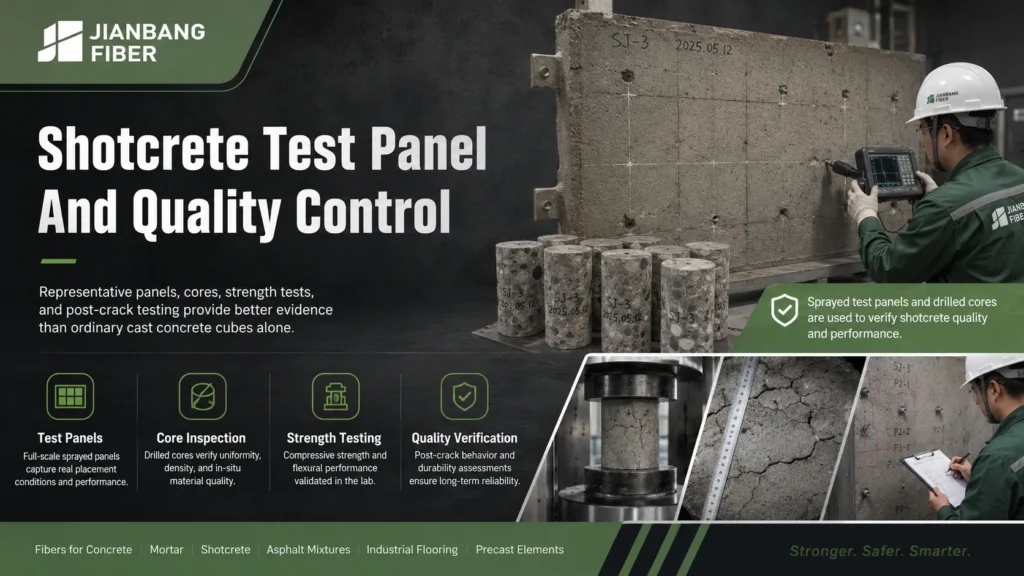
Ordinary cast cubes do not reproduce spray velocity, nozzle technique, rebound, layer interfaces, fiber retention, or compaction against the receiving surface.
Representative quality control should examine sprayed material.
Test Panels
ASTM C1140 covers the preparation of dry- or wet-mix shotcrete test panels. Specimens cut or cored from those panels may support preconstruction studies, nozzle-operator qualification, equipment assessment, quality control, and strength testing.
Drilled Cores
Cores taken from the completed work provide information about in-place thickness, compressive strength, splitting tensile strength, density, laminations, voids, shadowing, and layer continuity. ASTM C1604 specifically addresses obtaining and testing drilled shotcrete cores.
Post-Crack Testing
For fiber-reinforced shotcrete, compressive strength alone does not define structural performance.
ASTM C1550 evaluates the flexural toughness of fiber-reinforced concrete through a centrally loaded round panel. The resulting response reflects energy absorption after cracking, making the method relevant to many tunnel and mining applications. The active ASTM edition is currently listed as C1550-26.
EFNARC also publishes sprayed-concrete test-panel and flexural-testing guidance, including updated sprayed-concrete guidelines.
12 Common Shotcrete Mistakes
- Choosing dry or wet mix from habit
Project volume, access, spraying distance, stoppages, equipment, dust control, and required output should determine the process. - Copying an old water-cement ratio
A ratio that worked with one cement, accelerator, fiber, or machine may fail in another system. - Skipping cement–accelerator compatibility tests
Incompatible materials can produce unstable setting, poor early strength, or excessive later-age strength loss. - Increasing accelerator dosage without evaluating consequences
Faster setting does not automatically mean better support or better durability. - Comparing fibers only by tensile strength
Geometry, modulus, bond, orientation, retained dosage, and post-crack test results are equally important. - Replacing steel with synthetic fiber by equal mass
The two materials have very different densities and elastic moduli. - Ignoring rebound losses
The fiber and aggregate retained in the sprayed layer may differ from the original batch proportions. - Spraying over an unsuitable substrate
Dust, weak concrete, mud, ice, oil, or standing water reduces adhesion. - Trapping rebound behind reinforcement
Hidden rebound creates porous zones and poor structural continuity. - Accepting the work from cast cubes alone
Cast specimens do not represent actual nozzle placement or in-place defects. - Using an unqualified operator
Nozzle angle, distance, movement, air control, and spraying sequence directly influence quality. - Delaying curing
Exposed cement-rich surfaces can lose moisture rapidly, especially in warm, dry, or ventilated tunnels.
How To Select A Fiber For Shotcrete
Fiber selection should begin with the engineering requirement.
A project mainly concerned with plastic shrinkage may use polypropylene microfiber.
Tunnel support requiring high post-crack stiffness may be better suited to steel fiber.
Where corrosion, low weight, handling, or exposed ends matter, macro synthetic fiber deserves serious consideration.
The final specification should define:
- Required residual strength or energy absorption
- Layer thickness
- Dry- or wet-mix process
- Manual or robotic application
- Hose and nozzle dimensions
- Aggregate grading
- Expected rebound
- Accelerator type
- Environmental exposure
- Fire requirements
- Permitted crack behaviour
- Test-panel procedure
A full-scale spray trial should confirm pumpability, fiber passage, accelerator response, layer build-up, rebound, retained dosage, surface quality, core quality, and post-crack performance.
Why Choose Ecocretefiber™
Ecocretefiber™ is the construction-fiber brand of Shandong Jianbang Chemical Fiber Co., Ltd.
Our fiber range supports tunnels, mines, slopes, underground structures, structural repair, industrial floors, roads, bridges, precast concrete, and other infrastructure projects.
Shotcrete-related products include:
- Hooked-end steel fiber
- Glued steel fiber
- Steel fiber for tunnel support
- Macro synthetic fiber
- Polypropylene monofilament fiber
- Fibrillated polypropylene fiber
- Basalt fiber
- PVA fiber
The same fiber should not be promoted for every project.
A steel fiber that performs well in a heavy tunnel lining may not be the best option for a corrosion-sensitive mine. A lightweight synthetic fiber may simplify handling, but its dosage still needs to meet the specified residual performance. Micro polypropylene fiber can control early cracking, yet it does not provide the same structural toughness as a macrofiber.
Ecocretefiber™ supports contractors, distributors, ready-mix suppliers, tunnel companies, mining operators, and infrastructure buyers with fiber specification, packaging, dosage discussion, trial orders, OEM service, and application matching.
Buyer Checklist
| Question | Why It Matters |
|---|---|
| Is the process dry mix or wet mix? | It changes batching, feeding, pumping, and spraying requirements. |
| Is the layer temporary or permanent? | Permanent linings usually need stricter durability control. |
| What post-crack performance is specified? | Fiber dosage should follow tested structural performance. |
| What is the required layer thickness? | Thickness affects build-up, passes, and rebound. |
| Is corrosion a concern? | Macro synthetic fiber may offer an advantage. |
| What hose and nozzle are used? | Fiber and aggregate must pass without blockage. |
| Is the application manual or robotic? | Output and consistency may differ. |
| Which accelerator is selected? | Compatibility with cement must be tested. |
| Is silica fume included? | Cohesion, pumping, curing, and admixture demand may change. |
| Will sprayed test panels be produced? | Panels represent actual application better than cast cubes. |
| Will retained fiber content be checked? | Rebound changes the installed mixture. |
| Is the operator qualified? | Workmanship has a direct influence on finished quality. |
Conclusion
Shotcrete provides a fast and adaptable method for placing concrete on vertical, curved, overhead, and irregular surfaces.
Dry mix remains valuable for intermittent work, small repairs, long transport distances, and flexible nozzle water control. Wet mix offers controlled batching, higher output, lower dust, and strong compatibility with mechanized tunnel construction.
Silica fume improves cohesion and overhead build-up while helping reduce rebound. Accelerators provide rapid setting and early support, but their compatibility and later-age effects must be evaluated.
Fibers extend the role of shotcrete beyond compressive strength. Steel fiber provides high stiffness and strong crack bridging. Macro synthetic fiber offers lightweight, corrosion-free reinforcement. Neither should be selected through a simple kilogram comparison.
The decisive factors are coordination and verification. Mix design, equipment, accelerator, fiber, substrate preparation, spraying technique, curing, and testing must operate as one system.
Shandong Jianbang Fiber finds that reliable shotcrete comes from matching the material to the actual project—not from copying one traditional recipe.
Shandong Jianbang Chemical Fiber Co., Ltd. supplies Ecocretefiber™ steel and synthetic fiber solutions for tunnel support, mining, slope stabilization, structural repair, and other sprayed-concrete applications. Proper fiber selection can improve crack control, residual strength, durability, construction efficiency, and long-term project value.