Concrete carries compression very well, but it has limited tensile capacity. Shrinkage, temperature change, bending, impact, or restraint can create tensile stress. Once that stress exceeds the capacity of the cement matrix, a crack begins.
Fiber reinforced concrete uses short, discrete fibers to control how those cracks form and grow. The fibers spread through the mix. They work across many directions instead of sitting in one fixed reinforcement plane. A suitable fiber system can reduce early cracking, keep service cracks tighter, improve toughness, and help concrete retain useful capacity after the first crack.
The result still depends on engineering. Fiber material alone does not decide performance. Geometry, dosage, bond, orientation, mix design, batching, placement, finishing, and curing all matter. A product that works well in an industrial floor may not be the right choice for a thin precast panel or a tunnel lining.
At Shandong Jianbang Chemical Fiber Co., Ltd., we treat fiber selection as a performance decision. Ecocretefiber™ supplies steel, polypropylene, macro synthetic, and specialty fibers for concrete. This guide explains how these products work, how to design a workable mix, and how to avoid common construction problems.
What Is Fiber Reinforced Concrete?
Fiber reinforced concrete, often shortened to FRC, is a cement-based composite that contains fibers distributed through the fresh mix. The base material may be concrete, mortar, shotcrete, or another cementitious system. The fibers can be metallic, synthetic, mineral, or plant-based.
ASTM C1116/C1116M-23 covers fiber reinforced concrete delivered with its ingredients uniformly mixed. That point is important. FRC is not concrete with a few visible strands added at the end. It needs a controlled fiber type, a defined dosage, and uniform dispersion.
Fiber reinforcement also differs from conventional reinforcing steel.
- Rebar carries tensile force at designed positions.
- Welded wire reinforcement works in a planned plane.
- Fibers work throughout the concrete volume and across random crack paths.
These systems can work together. Fibers often supplement rebar by controlling cracks between bars, improving impact resistance, or supporting early-age performance. In selected slabs, pavements, shotcrete systems, and precast elements, tested macro fibers or steel fibers may reduce or replace secondary reinforcement. The structural engineer must still confirm that decision. Micro polypropylene fiber should not be presented as a general replacement for primary structural reinforcement.
How Fiber Reinforced Concrete Works
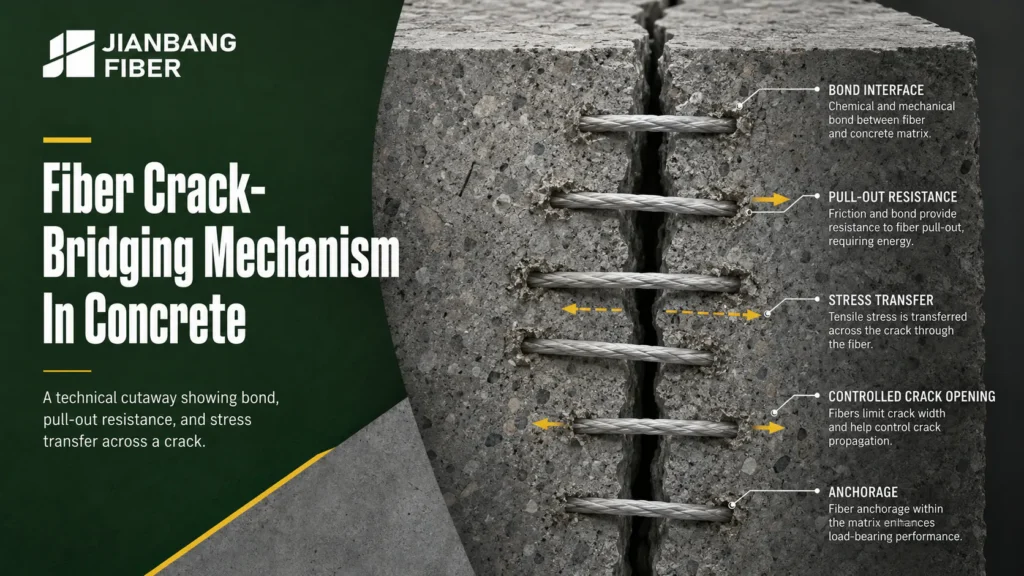
The main mechanism is crack bridging.
Before a crack forms, the cement matrix carries most of the stress. The fibers may help restrain small internal movements, but their most valuable work begins when a crack tries to open. Fibers that cross the crack connect the two faces. Bond and mechanical anchorage transfer stress from the matrix into the fiber.
The fiber then resists pull-out, stretching, or rupture. That resistance slows the crack opening. It can also spread damage across several smaller cracks instead of allowing one crack to widen quickly.
FHWA research explains that many conventional fibers contribute mainly after the matrix has cracked. This is why compressive strength alone does not describe FRC well. Residual flexural strength, toughness, energy absorption, and crack width often give a clearer view of its value.
Several factors control crack-bridging efficiency:
- Fiber strength and stiffness. A strong, stiff steel fiber can transfer a high force. A flexible polymer fiber may allow more deformation while holding the crack together.
- Bond with the matrix. Surface texture, chemical adhesion, friction, and mechanical anchorage affect pull-out resistance.
- Geometry. Length, diameter, aspect ratio, end shape, embossing, crimping, or twisting change how the fiber engages the concrete.
- Orientation. A fiber works best when it crosses the crack at an effective angle. Placement flow and vibration can create preferred orientation.
- Distribution. A uniform network gives more reliable crack interception than clumps or fiber-free zones.
- Dosage. Too little fiber may miss the target. Too much may reduce workability and cause poor dispersion.
- Matrix quality. Paste volume, aggregate grading, water-cement ratio, admixture system, and curing affect bond and overall performance.
Main Types Of Fiber Reinforced Concrete
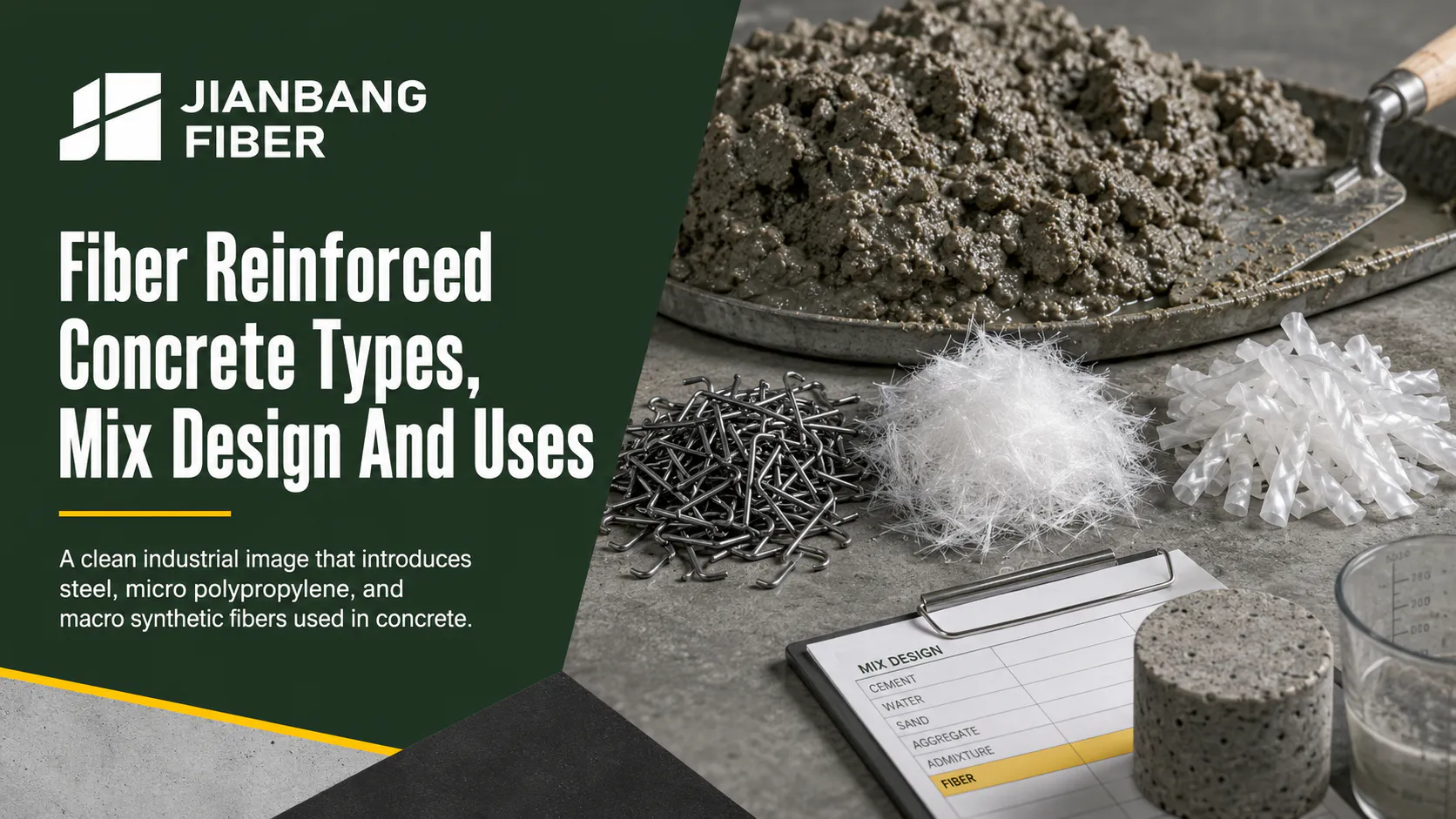
The word “fiber” covers many materials. Buyers should start with the required function, then compare material families.
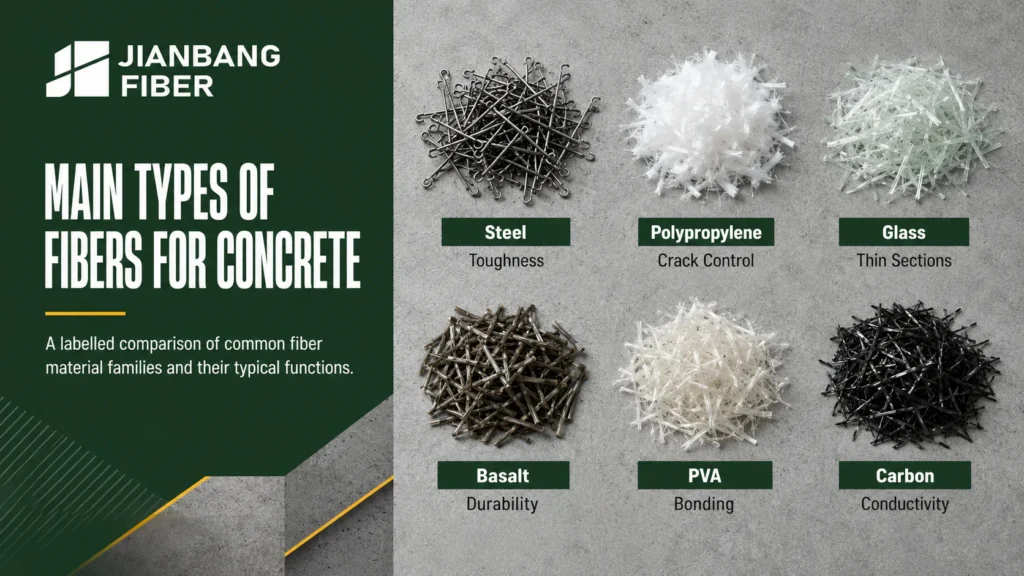
| Fiber Family | Main Strength | Typical Use | Key Design Note |
| Steel fiber | High stiffness, strong crack bridging, high residual capacity | Industrial floors, pavements, bridge decks, tunnels, shotcrete, precast, UHPC | Shape, aspect ratio, tensile strength, corrosion exposure, and dosage must match the project. |
| Micro polypropylene fiber | Early-age crack control, low density, no corrosion | Slabs, screeds, mortar, overlays, precast, fire-spalling mitigation | It mainly targets plastic shrinkage and fresh-concrete behavior. |
| Macro synthetic fiber | Corrosion-free toughness and post-crack performance | Ground-supported slabs, pavements, shotcrete, tunnels, precast | Use residual-strength test data when the fiber has a structural or mesh-replacement role. |
| AR glass fiber | Alkali-resistant reinforcement for thin cement products | GRC panels, decorative components, thin precast sections | Ordinary E-glass is not a direct substitute for alkali-resistant glass in cement. |
| Basalt fiber | Mineral reinforcement with heat and chemical resistance | Mortar, concrete, pavement, repair, selected infrastructure | Surface treatment and long-term alkali performance need review. |
| PVA, PAN, UHMWPE, or carbon fiber | High-bond or high-performance crack control | ECC, repair materials, conductive systems, UHPC, specialty composites | Cost, dispersion, bond, and the required strain behavior drive selection. |
| Plant or cellulose fiber | Low density and fresh-material control | Boards, mortar, plaster, low-load cement products | Moisture absorption, durability, and treatment require careful control. |
Steel Fiber Reinforced Concrete
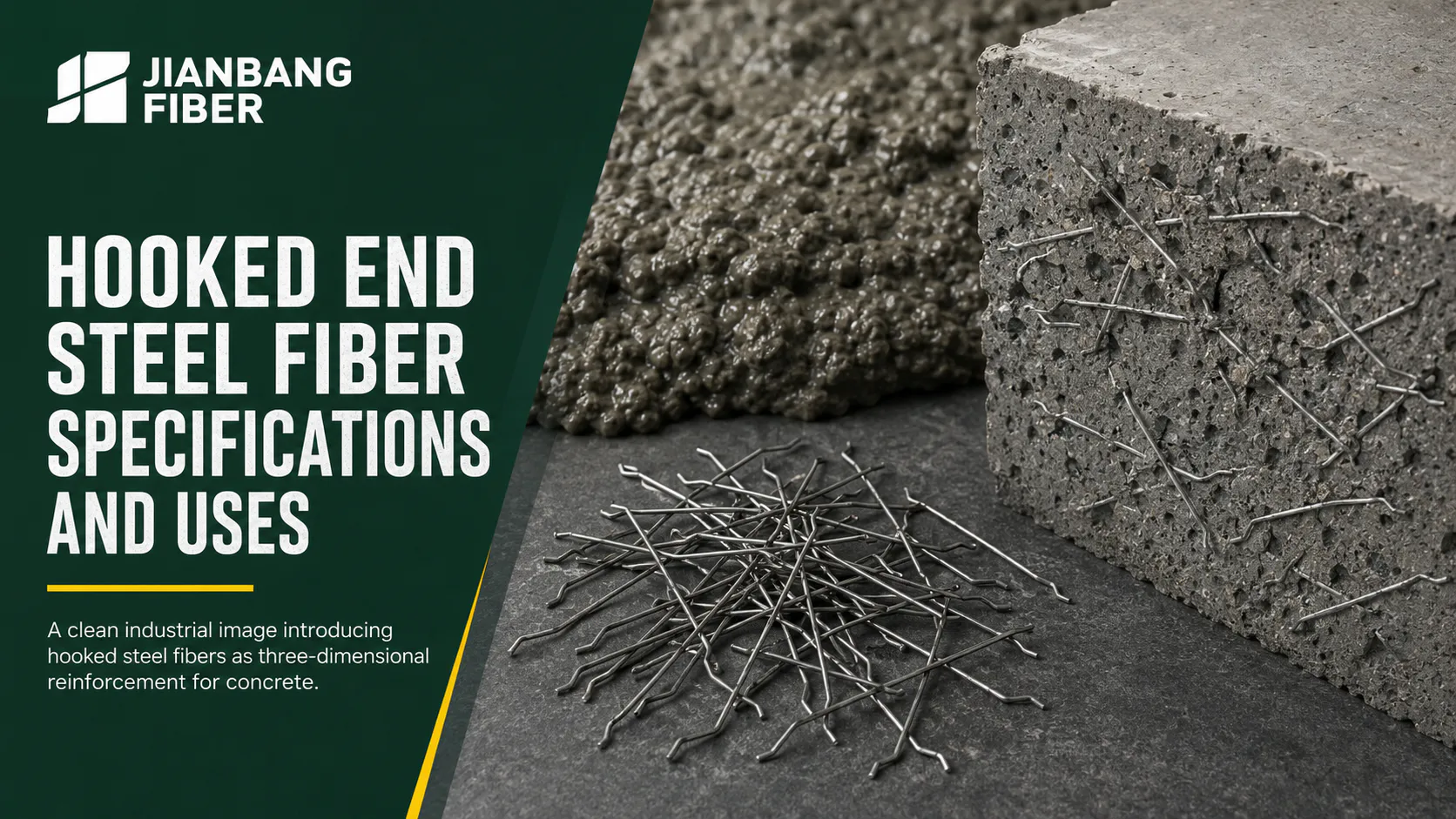
Steel fiber is usually chosen when concrete needs strong post-crack behavior. Common forms include straight, indented, crimped, hooked-end, glued, milled, and micro copper-coated fibers.
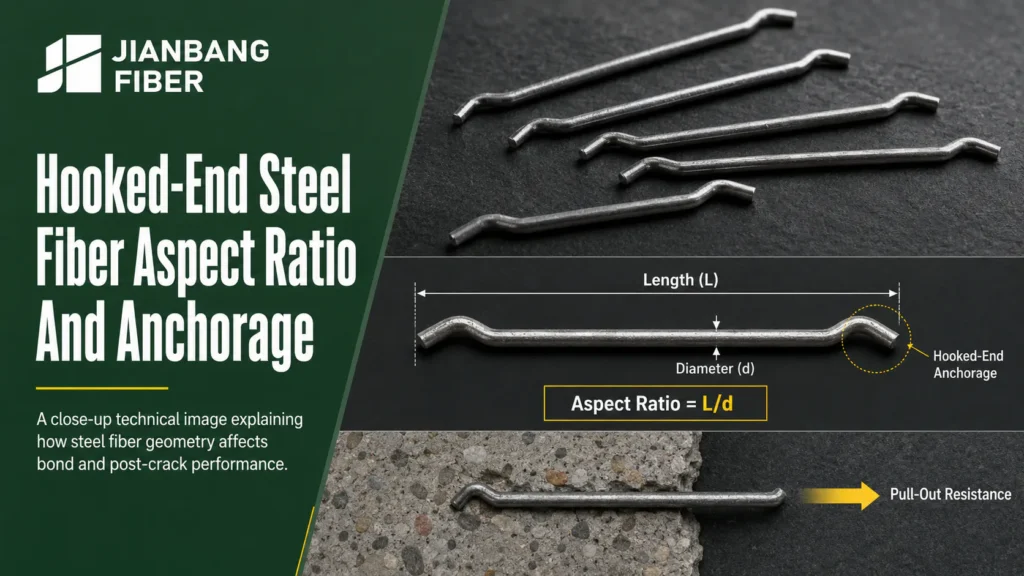
Steel fibers have high tensile strength and a high elastic modulus. They can resist crack opening at relatively small deformations. Hooked or deformed ends also improve mechanical anchorage. A hooked-end steel fiber can develop higher pull-out resistance than a smooth straight fiber with a similar size.
Length divided by diameter gives the aspect ratio. Traditional steel FRC references often show aspect ratios around 30 to 80, while many products remain below about 100 to protect workability. These figures are useful screening ranges, not universal limits. A higher aspect ratio may improve crack bridging, but it can also increase internal friction and balling risk.
Conventional steel fiber contents often fall within a broad range of about 0.5% to 2% by volume. Actual project dosages are often specified in kilograms per cubic metre. Floors, pavements, shotcrete, and UHPC can require very different levels. The final value must come from design calculations, supplier data, trial mixes, and the required residual performance.
Micro And Macro Polypropylene Fibers
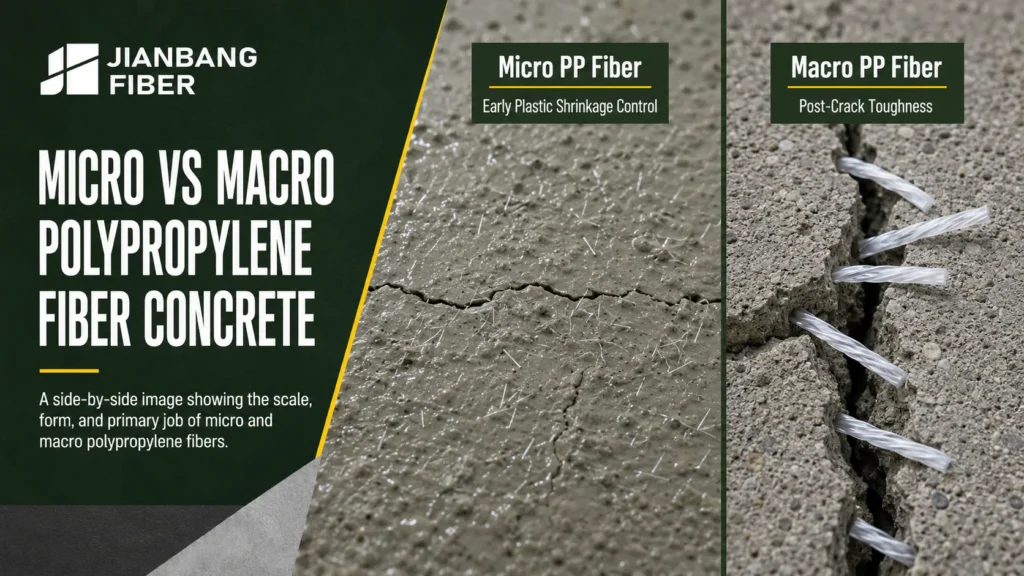
Polypropylene fiber includes several forms. A micro monofilament is very fine. A fibrillated or mesh fiber opens into a network during mixing. A macro synthetic fiber is longer, thicker, and stiffer.
Micro polypropylene fiber mainly works in fresh and early-age concrete. It helps distribute tensile stress while the concrete is still weak. It can reduce plastic shrinkage cracking, limit plastic settlement cracks, and support mix cohesion. NRMCA CIP 24 describes synthetic fibers as an internal support system that bridges and disperses cracks.
Macro polypropylene or synthetic PP macrofiber has a different job. It improves toughness and post-crack behavior in hardened concrete. It is also light, non-corrosive, and non-conductive. These qualities make it attractive for slabs, pavements, tunnel support, shotcrete, and aggressive environments.
Polypropylene microfibers also have a specialized fire role. In dense concrete, selected microfibers can melt during rapid heating and help create pressure-release paths. This may reduce explosive spalling risk. That use needs a tested fire design. It should not be confused with post-fire structural reinforcement.
What Performance Can Fibers Improve?
Fiber concrete is often marketed as “stronger concrete,” but that phrase is too broad. Different fibers improve different properties.
Plastic Shrinkage Crack Control
Fresh concrete may lose water from the surface faster than bleed water can replace it. Wind, low humidity, heat, or a large exposed area can raise the risk. Micro synthetic fibers create many small bridges in the weak plastic matrix. They can reduce crack area and crack width when the dosage, finishing, and curing are suitable.
Fibers do not replace curing. Evaporation control, wind protection, fogging, curing compound, wet curing, and correct finishing time still matter.
Toughness And Residual Strength
Plain concrete can lose load-carrying capacity quickly after cracking. Steel fibers and macro synthetic fibers can keep transferring stress across the crack. This produces a more gradual failure response. It also improves energy absorption.
This behavior matters in industrial floors, pavements, shotcrete, tunnel linings, precast units, and impact-prone components. ASTM C1609/C1609M-24 evaluates flexural performance from the load-deflection response of a beam. The test shows what the material can carry after the first crack, not only its peak load.
Tensile, Flexural, Impact, And Fatigue Behavior
Fibers can improve tensile and flexural response because they restrain crack growth. They can also increase impact resistance and fatigue endurance. FHWA test summaries have reported large gains in first-crack strength, flexural strength, post-crack capacity, and energy absorption for certain steel-fiber systems. The exact gain depends on fiber type, volume, geometry, and matrix quality.
Compressive strength may increase, stay similar, or even fall if workability and consolidation become poor. A successful FRC mix should not be judged by compressive strength alone.
Durability Support
Tighter cracks can slow the movement of water, chlorides, and other aggressive agents. This can support durability. The fiber itself must also suit the exposure. Polypropylene does not rust. Steel fiber has strong mechanical performance, but surface exposure and corrosion risk need review. AR glass, basalt, or other mineral fibers need proven resistance in the cement environment.
How To Design A Fiber Reinforced Concrete Mix
A good FRC mix starts with a performance target, not a fiber bag.
1. Define The Required Function
The project team should state the problem first.
- Plastic shrinkage cracking calls for micro synthetic fiber.
- Residual strength may call for steel or macro synthetic fiber.
- High impact or heavy wheel loads may favour hooked-end steel fiber.
- Corrosive exposure may favour macro polypropylene fiber.
- Thin architectural panels may use AR glass fiber.
- Fire-spalling mitigation may use a tested micro polypropylene system.
One fiber cannot solve every problem.
2. Keep A Stable Base Concrete
The base mix needs suitable strength, paste volume, aggregate grading, workability, and durability. Fibers cannot repair a poorly proportioned mix. A harsh mix with low mortar content can make dispersion difficult. Poorly graded aggregate can raise the risk of clumping.
Older steel-FRC guidance often recommends a higher mortar fraction, controlled aggregate size, and a lower water-cement ratio. Those principles remain useful, but one fixed aggregate limit does not fit every fiber. The maximum aggregate size should match the fiber length, section thickness, pump line, reinforcement spacing, and placing method.
3. Select Dosage By Performance
Dosage can be stated by mass or volume. The two methods should not be mixed.
Micro polypropylene fibers often use a low mass dosage. Macro synthetic fibers use more material because they need to carry post-crack load. Steel fibers have a much higher density, so their mass dosage can look large even at a moderate volume fraction.
The supplier’s recommended range is a starting point. Structural or post-crack claims need test data. The most reliable choice comes from trial batches and performance testing at the proposed dosage.
4. Protect Workability Without Adding Extra Water
Fibers increase surface area and internal friction. Slump or flow may fall after addition. Extra water may restore apparent workability, but it can weaken the matrix and increase shrinkage.
Use a suitable water-reducing or high-range water-reducing admixture when the mix needs more flow. Adjust paste volume and aggregate grading if needed. Record the slump or flow before and after fiber addition during the trial.
5. Check Pumping, Placing, And Finishing
Long or deformed fibers may affect pump pressure, hose flow, surface finishing, and screed operation. A laboratory batch cannot reveal every site issue. A full-scale plant trial or trial panel is valuable for demanding projects.
How To Mix Fiber Reinforced Concrete
Uniform dispersion is the main production goal. Poor mixing creates fiber balls, weak zones, blocked pump lines, and uneven performance.
Two practical sequences are common.
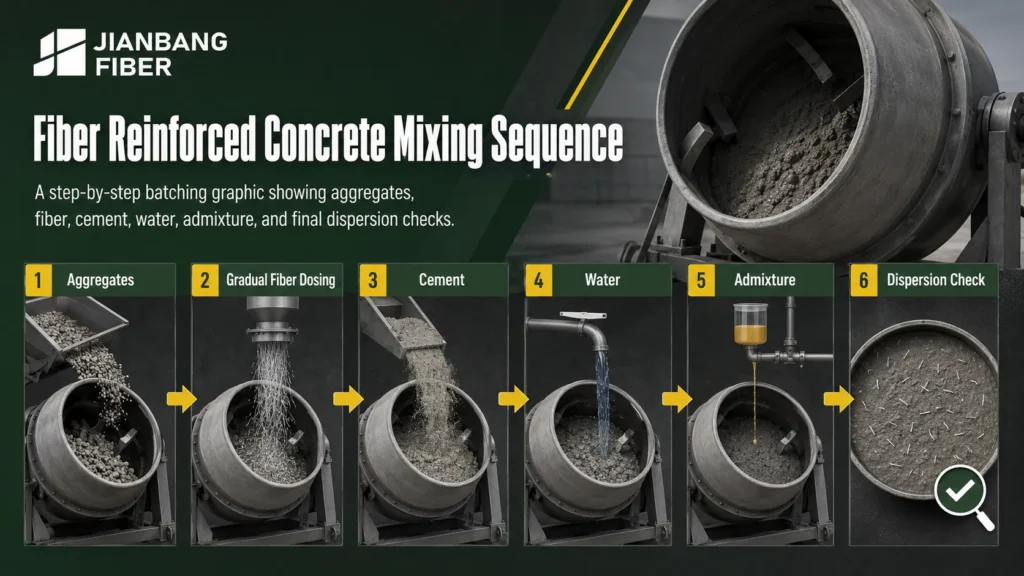
Dry-distribution sequence
- Charge part or all of the coarse and fine aggregate.
- Add the fibers gradually while the drum or mixer is moving.
- Add cementitious materials.
- Add water and admixtures.
- Mix until the fibers are separated and uniformly distributed.
Plastic-concrete sequence
- Produce a workable base concrete.
- Add fibers through a controlled feeder or in small portions.
- Keep the mixer turning during addition.
- Continue mixing for the validated time.
- Check dispersion, slump, and visible clumps before discharge.
The right sequence depends on fiber form, packaging, mixer type, batch size, and plant layout. Glued steel-fiber bundles and water-soluble inner bags can make dosing easier. The binder or bag must separate fully during mixing.
Crews should never dump a full fiber dose into one point. They should also avoid adding dry fiber to a stationary mixer. Gradual addition gives the mixer time to separate each portion.
Construction And Quality-Control Risks
| Site Symptom | Likely Cause | Practical Action |
| Fiber balls or clumps | Fast dumping, dry mix, high aspect ratio, poor grading, or short mixing time | Slow the feed rate, improve the sequence, verify moisture, and extend mixing to the validated time. |
| Large slump loss | High fiber surface area or insufficient admixture response | Use a compatible water reducer. Do not add uncontrolled water. |
| Fibers visible at the surface | Excessive finishing, poor paste coverage, wrong fiber length, or unsuitable finishing method | Review paste volume, finishing timing, fiber length, and screed method. |
| Uneven residual performance | Non-uniform dosage, poor dispersion, segregation, or strong fiber orientation | Calibrate dosing, inspect batches, control flow, and test specimens taken from representative locations. |
| Pump blockage | Fiber too long for the line, clumps, low workability, or poor sequence | Review fiber length, hose diameter, bends, mix flow, and trial pumping. |
| Good compressive strength but weak post-crack result | Wrong fiber geometry, low dosage, weak bond, or poor orientation | Use residual flexural testing and adjust the fiber system rather than only the cement content. |
Placement also changes fiber orientation. Concrete flowing through a narrow section may align fibers with the flow. Vibration can improve consolidation, but excessive vibration may cause settlement or orientation changes. A designer should consider how test specimens compare with the actual element.
Curing remains essential. Fibers help control cracks, but they do not stop moisture loss or hydration. Poor curing can still create surface cracking, curling, dusting, and low durability.
Tests And Standards That Matter
Buyers should match the test to the promised benefit.
- ASTM C1116/C1116M covers delivered fiber reinforced concrete with uniformly mixed ingredients.
- ASTM C1579 compares plastic shrinkage cracking in restrained fiber reinforced concrete panels.
- ASTM C1609/C1609M measures flexural performance, including post-crack load and toughness from a load-deflection curve.
- ASTM A820/A820M classifies and specifies steel fibers for fiber reinforced concrete.
- ASTM D7508/D7508M covers polyolefin chopped strands, including micro, macro, and hybrid synthetic fibers.
- EN 14889-1 and EN 14889-2 cover steel fibers and polymer fibers for concrete in markets that use the EN framework.
A product certificate alone does not prove a concrete design. The project still needs the correct mix, dosage, production control, specimen preparation, and acceptance criteria.
For a structural or mesh-replacement claim, ask for residual-strength data at the proposed dosage. For plastic shrinkage control, ask for a relevant crack-reduction test. For tunnel fire exposure, ask for fire-test evidence that matches the concrete system.
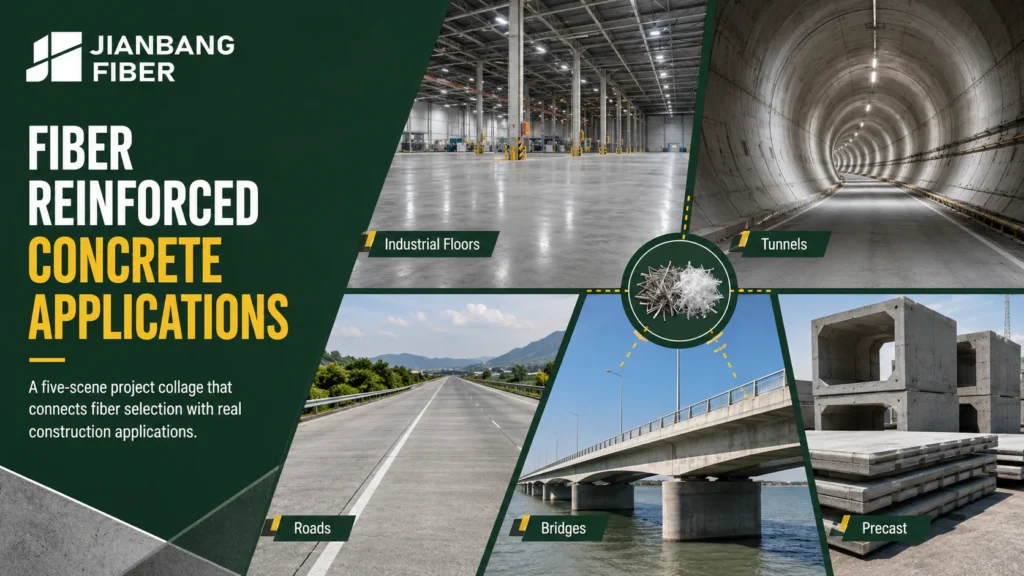
Where Fiber Reinforced Concrete Is Used
FRC is used wherever cracks, impact, fatigue, construction speed, or post-crack integrity matter.
Industrial Floors And Warehouses
Steel or macro synthetic fibers help control service cracks and improve toughness under forklift traffic, racks, point loads, and repeated wheel movement. Micro polypropylene fiber can also support early-age crack control.
Roads, Pavements, Bridge Decks, And Overlays
Distributed fibers help resist crack growth, repeated loading, impact, and edge damage. Steel fiber is common where high residual capacity is needed. Macro synthetic fiber offers a corrosion-free option in selected designs.
Tunnels, Mines, And Shotcrete
Fibers reinforce the sprayed layer throughout its thickness. Steel or macro synthetic fibers can improve energy absorption and post-crack integrity. Micro polypropylene fiber may support fire-spalling mitigation in a tested tunnel-lining design.
Precast Concrete
Fibers can reduce handling cracks, improve impact resistance, support thin sections, and simplify some reinforcement tasks. Product geometry and surface requirements should match the mould, compaction method, and finishing process.
Hydraulic, Marine, And Water-Retaining Work
Tighter crack control can support watertightness and durability. The fiber material needs to suit wet, chloride, chemical, or abrasive exposure.
UHPC And High-Performance Cement Composites
High-strength steel, PVA, PE, UHMWPE, or other engineered fibers can create strong crack-bridging behavior. These mixes demand careful control of dispersion, orientation, rheology, and heat treatment or curing.
How To Choose The Right Fiber Supplier
A buyer should compare total project value, not only price per kilogram.
Ask these questions before ordering:
- What crack or load problem must the fiber solve?
- Is the fiber acting in fresh concrete, hardened concrete, or both?
- What residual strength or crack-reduction evidence is available?
- Which length, diameter, shape, and tensile strength fit the mix?
- What dosage range has been tested?
- Will the fiber pass through the available pump and placing equipment?
- Can the supplier provide a TDS, SDS, COA, test reports, and batch identification?
- Can packaging be matched to one-bag-per-batch dosing?
- Is a plant trial or trial panel planned before full production?
- Does the proposal respect the engineer’s reinforcement design?
Stable fiber dimensions are important. Clean cutting, controlled surface form, consistent tensile properties, and reliable packaging all affect site results. A low-cost fiber can become expensive if it clumps, blocks equipment, or forces a rejected pour.
Why Work With Shandong Jianbang And Ecocretefiber™?
Shandong Jianbang Chemical Fiber Co., Ltd. manufactures and supplies concrete reinforcement fibers through the Ecocretefiber™ brand. Our range includes polypropylene fibers, steel fibers, macro synthetic fibers, PVA, PAN, UHMWPE, basalt, AR glass, carbon, cellulose, and other specialty products.
Our role starts before shipment. We help contractors, ready-mix plants, precast producers, distributors, and project owners compare:
- Fiber material and form
- Length, diameter, and aspect ratio
- Tensile strength and elastic modulus
- Crack-control or residual-strength target
- Dosage range and mixing sequence
- Inner-bag size, pallet plan, and OEM packaging
- Required TDS, SDS, COA, ISO 9001, and project inspection documents
We do not recommend one fiber for every project. A warehouse floor, tunnel lining, bridge deck, repair mortar, and precast element have different needs. Our team can use the project application, base mix, equipment, and performance target to narrow the selection. Trial mixing then confirms workability and dispersion before large-volume use.
Factory-direct supply also gives buyers better control over specifications. Length, colour, inner-pack weight, labels, and pallet plans can be discussed for distributor or project orders. Batch documentation supports traceability and repeat purchasing.
Conclusion
Fiber reinforced concrete works because distributed fibers intercept cracks and transfer stress across them. Micro fibers mainly support early crack control. Steel and macro synthetic fibers can improve toughness, residual capacity, impact resistance, and fatigue behavior. Specialty fibers can solve more focused needs in GRC, UHPC, repair, fire, and high-performance composites.
The best result comes from a complete system. The fiber must match the required function. The mix needs enough workability and paste quality. The batching sequence must produce uniform dispersion. Placement, finishing, and curing must protect the concrete. Performance tests must confirm the claim that matters to the project.
If you are selecting fibers for an industrial floor, pavement, bridge, tunnel, shotcrete system, precast product, or specialty concrete, contact Shandong Jianbang Chemical Fiber Co., Ltd. Ecocretefiber™ can help you compare fiber types, plan a trial mix, prepare technical documents, and build a supply plan for your market.