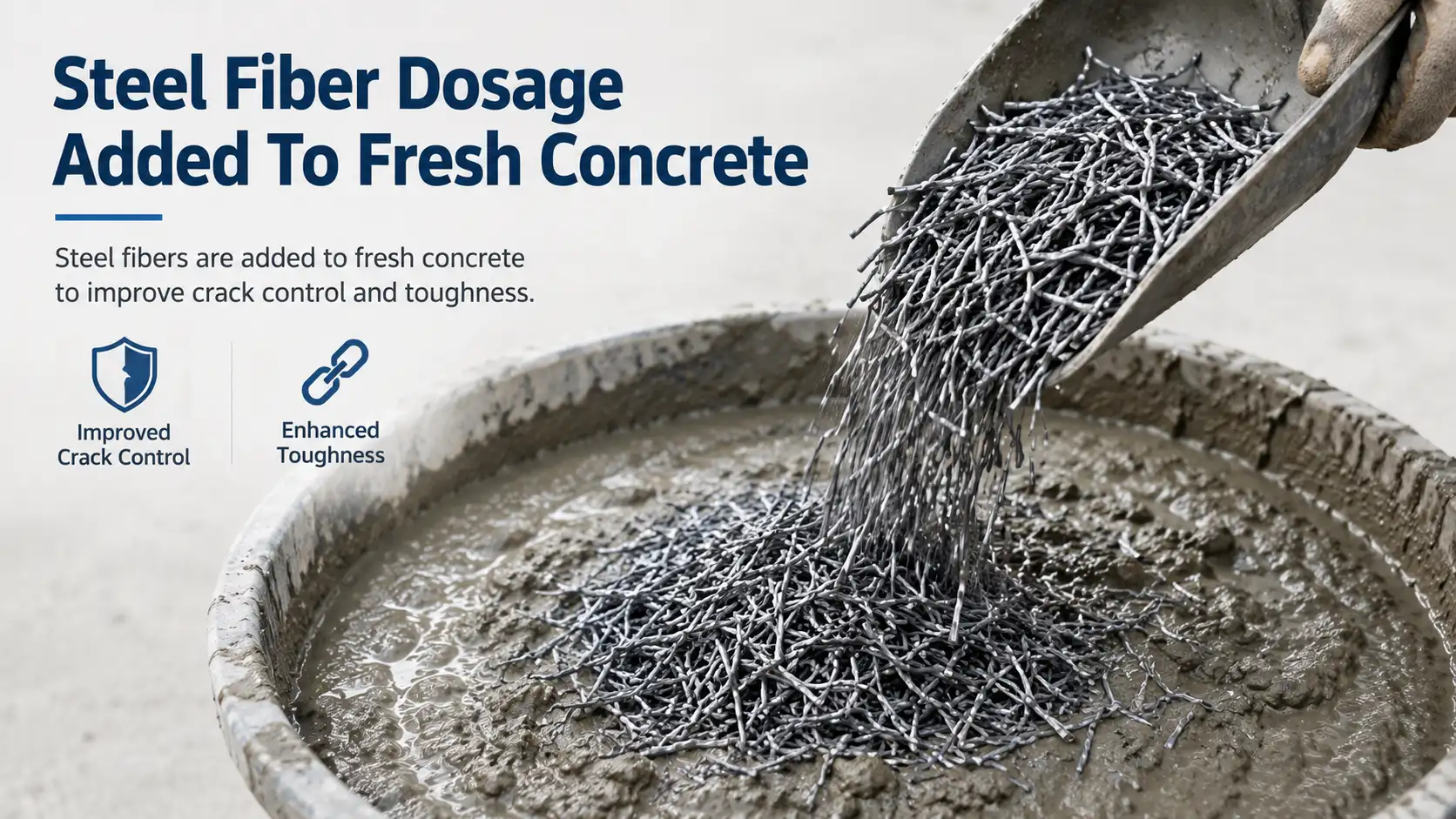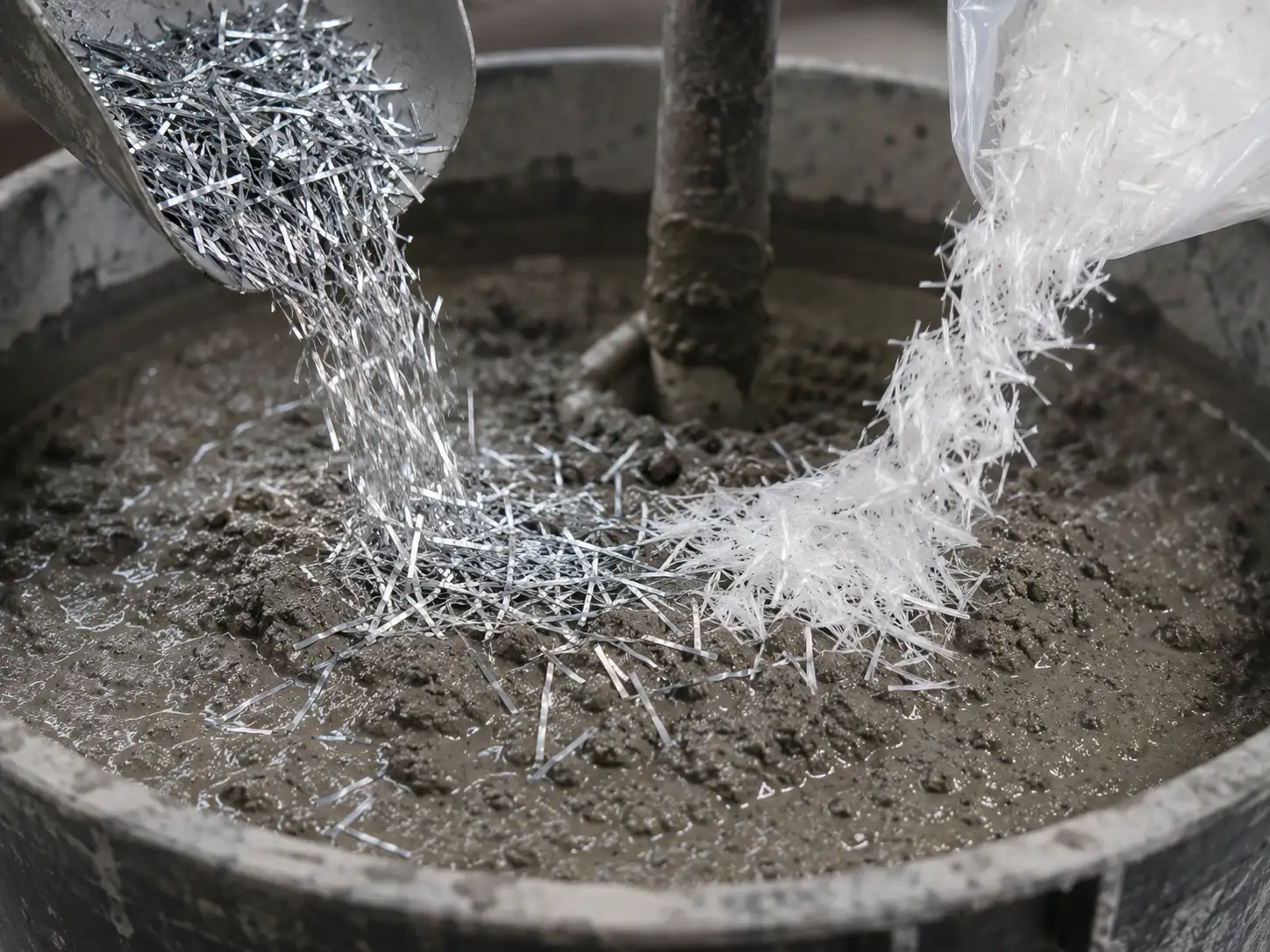
Hybrid fiber reinforced concrete is a concrete mix that uses more than one type of fiber. The goal is simple. The mix should control cracks at different stages. It should improve toughness after cracking. It should make concrete less brittle during service.
Concrete has high compressive strength. This is why engineers use it for slabs, beams, tunnels, roads, precast parts, and many other structures. Still, concrete has a clear weakness. It is brittle under tension. It can crack when shrinkage, bending, impact, temperature change, or load movement creates tensile stress inside the matrix.
Fiber reinforcement helps solve this problem. A single fiber can improve one part of the performance. A hybrid fiber system can do more. It can use different fibers for different crack widths and different stress stages. This is the main reason many concrete projects now consider hybrid fiber reinforced concrete.
Au Shandong Jianbang Chemical Fiber Co, Ltd., we supply concrete fiber solutions under the Ecocretefiber™ brand. Our aim is not only to sell fiber. Our aim is to help contractors, ready-mix plants, precast producers, and distributors select a fiber system that matches the job site, mix design, and performance target.
What Is Hybrid Fiber Reinforced Concrete?
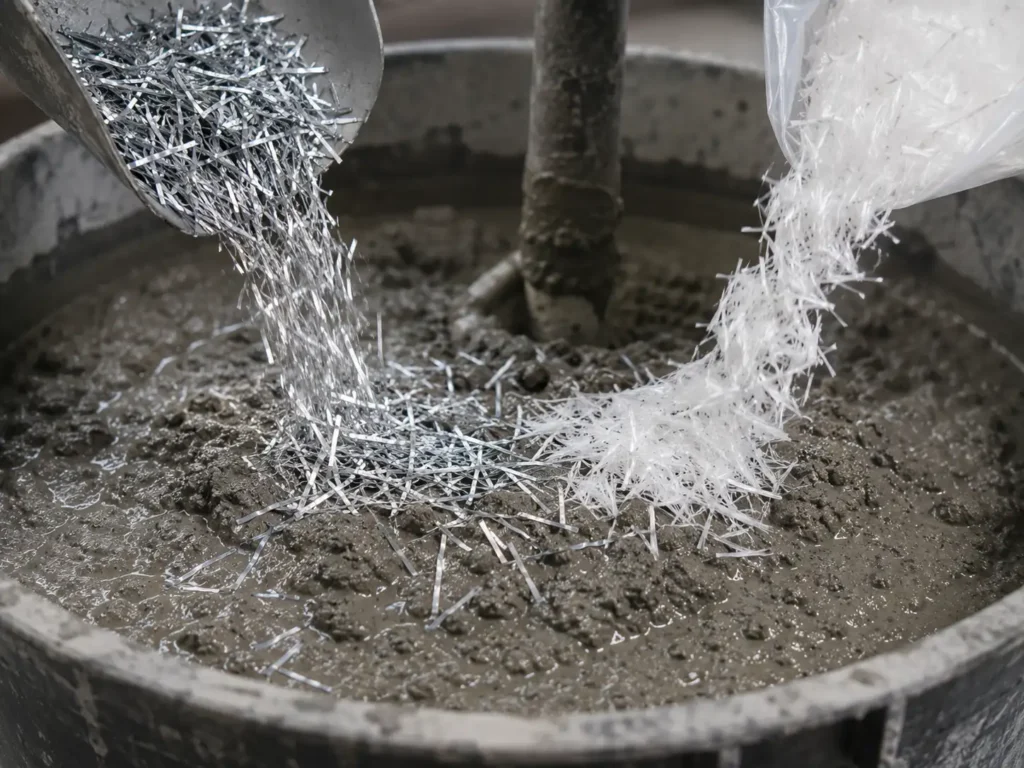
Hybrid fiber reinforced concrete is concrete that contains two or more fiber types in one mix. A common system uses fibre d'acier et fibre de polypropylène. Another system may use macrofibre synthétique et micro fibre de polypropylène. Some advanced cement-based materials may also use Fibre PVA, mineral whiskers, or other micro-scale materials.
The basic idea is easy to understand. Concrete cracks do not form in one single step. Small microcracks appear first. These cracks grow into visible cracks. Some cracks then become wider under load. Large cracks may finally control the failure of the concrete element.
Different fibers work better at different crack stages.
Micro polypropylene fibers help reduce early plastic shrinkage cracking. They disperse through the cement paste and help control very small cracks. Macro synthetic fibers or steel fibers can bridge larger cracks. They can hold the crack faces together after the concrete has cracked. This post-crack action is one of the most important values of fiber reinforced concrete.
ASTM C1116 covers fiber-reinforced concrete and classifies it by fiber type, including steel, glass, synthetic, and natural fibers. It also states that the fiber-reinforced concrete should be uniformly mixed when delivered to the purchaser.
Why Concrete Needs Fibers
Plain concrete can carry compression well. It does not carry tension in the same way. Once a crack opens, the cracked section loses tensile capacity quickly. This is why many concrete structures use steel bars. Steel bars provide structural reinforcement. Fibers serve a different role.
Fibers spread through the concrete matrix. They create many small bridges inside the mix. These bridges help limit crack growth. They also help the concrete keep some load capacity after cracking.
This does not mean fibers can replace all steel reinforcement in every structure. That is not correct. Engineers must design the structure based on load, code, span, exposure, and safety needs. But fibers can improve the behavior of concrete in many practical areas. These areas include slabs-on-ground, tunnel shotcrete, industrial floors, precast elements, repair mortar, overlays, and crack-sensitive concrete surfaces.
ASTM C1609 evaluates flexural performance of fiber-reinforced concrete by using load-deflection data from a beam test. It also uses first-peak strength, residual strength, and toughness to describe performance after cracking.
Why Hybrid Fibers Can Work Better Than One Fiber
A single fiber type has limits. Microfibers are very good at controlling early microcracks, but they do not provide the same post-crack residual flexural capacity as a strong macro fiber. Steel fibers can provide strong crack bridging, but they may not disperse in the same way as fine synthetic fibers at the paste level. Macro fibres synthétiques offer corrosion-free crack control, but they must be selected with the right length, shape, tensile strength, and dosage.
Hybrid fibers use the strengths of each fiber type.
A micro fiber can work inside the paste. It can help before cracks become visible. A macro fiber can work after cracks grow. It can bridge larger cracks. Steel fiber can provide high stiffness and high pull-out resistance. A macro synthetic fiber can provide corrosion-free toughness and easier handling in many job-site conditions.
This is why hybrid fiber reinforced concrete should be discussed as a crack-control system, not just as a material with “more fiber.”
The Multi-Scale Crack Control Concept
Concrete failure is a multi-scale process. The material contains hydration products at the micro level, mortar at the middle level, and coarse aggregate at the macro level. Cracks also move through these levels. They start small. They grow. They join with other cracks. They finally form larger cracks.
A good hybrid fiber system should match this process.
| Crack Scale | Typical Fiber Choice | Main Role In Concrete | Practical Value |
|---|---|---|---|
| Microcrack stage | Fibre de micro polypropylène | Controls early small cracks | Helps reduce plastic shrinkage cracking |
| Fine crack stage | PVA fiber or fine synthetic fiber | Limits small crack growth | Helps improve toughness and crack distribution |
| Macro crack stage | Steel fiber or macro synthetic fiber | Bridges wider cracks | Helps improve post-crack load capacity |
| Service stage | Macro synthetic fiber or steel fiber | Holds crack faces together | Helps improve durability and impact resistance |
This concept is useful for project owners. It explains why a mix with more than one fiber can give better crack behavior than a single-fiber mix. It also explains why the right dosage matters. Too little fiber may not create enough bridges. Too much fiber may reduce workability, raise air content, or make mixing harder.
What The Research Shows About Strength
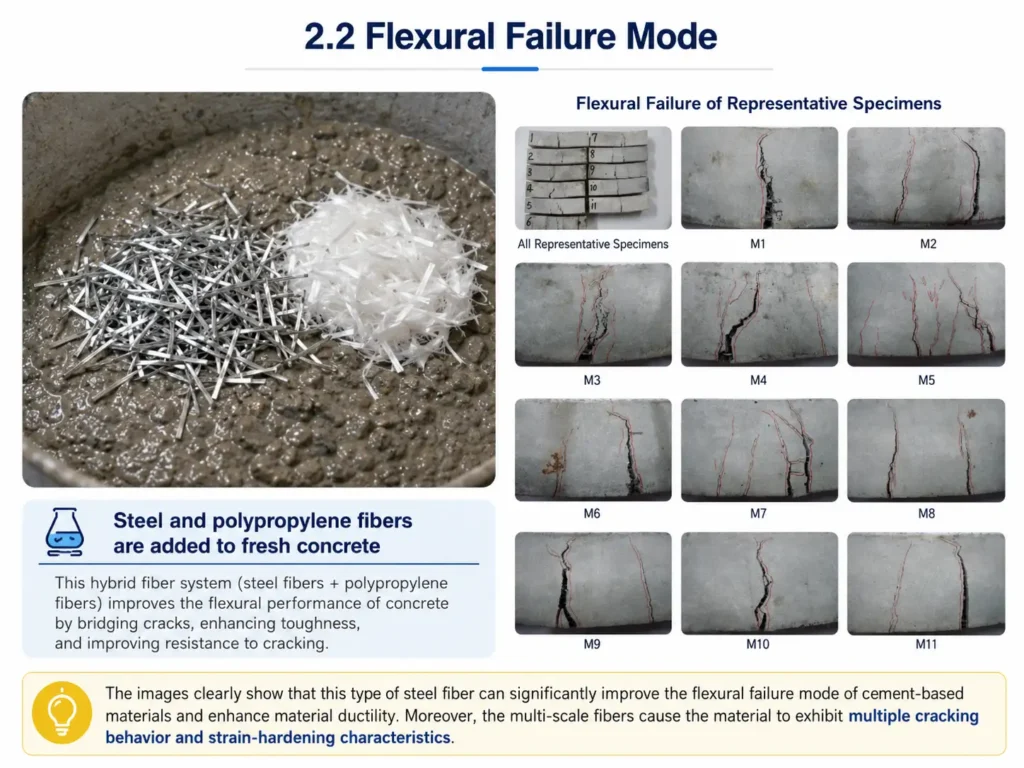
Many buyers ask one question first. Does fiber increase compressive strength?
The practical answer is: fiber is not mainly used to increase compressive strength.
Some research shows that steel fibers can improve compressive strength in certain mixes. Some hybrid systems may also show a small increase. But the stronger and more reliable value is usually seen in tensile behavior, splitting strength, flexural behavior, toughness, and post-crack performance.
This matters for marketing and project communication. A concrete fiber supplier should not only say, “Our fiber makes concrete stronger.” That sentence is too simple. It can also create the wrong expectation.
A better message is this:
Concrete fibers help control cracking, improve toughness, and support post-crack performance when the fiber type, dosage, and mix design are correct.
This message is more professional. It also matches how engineers evaluate fiber reinforced concrete.
Steel Fiber And Polypropylene Fiber In One Mix
Steel fiber and polypropylene fiber are a common hybrid pair. Steel fiber has high modulus and high tensile strength. It can improve load transfer across cracks. It can support residual capacity after cracking. Polypropylene fiber is light, synthetic, and corrosion-free. Fine polypropylene fiber is useful for plastic shrinkage crack control. Macro polypropylene or macro synthetic fiber can help bridge larger cracks in slabs and shotcrete.
When these two fibers are used together, they can work at different stages. Polypropylene fiber can help control early crack formation. Steel fiber can support the cracked section at a higher load stage.
This does not mean every project should use steel and polypropylene together. The right system depends on the application.
For industrial floors, macro synthetic fibers may be preferred when corrosion risk is a concern. For tunnel shotcrete, steel fiber or macro synthetic fiber may be selected based on design requirements, rebound control, and testing data. For precast concrete, the producer may need a fiber that mixes evenly and does not harm surface finish. For repair mortar, crack control and bonding behavior may be more important than high fiber volume.
Micro Fiber Vs Macro Fiber
Micro fiber and macro fiber should not be treated as the same product. They are used for different reasons.
Micro polypropylene fiber is usually fine and short. It spreads through the cement paste. It helps reduce plastic shrinkage cracks. It is common in plaster, mortar, slabs, precast elements, and concrete surfaces that need early crack control.
Macro synthetic fiber is larger. It is designed to bridge cracks after the concrete hardens. It can improve toughness and residual flexural performance. It is often used in slabs-on-ground, shotcrete, tunnel linings, precast concrete, and concrete repair.
EN 14889-2 covers polymer fibers for structural or non-structural use in concrete, mortar, and grout. It also includes applications such as sprayed concrete, flooring, precast, in-situ concrete, and repair concrete.
This standard view helps buyers understand one important point. Polymer fibers are not only for small crack control. Some macro polymer fibers are designed for residual flexural strength and structural contribution when the design allows it.
How Hybrid Fibers Improve Flexural Performance
Flexural performance is one of the most useful ways to judge fiber reinforced concrete. A plain concrete beam can fail suddenly after the first crack. A fiber reinforced beam can keep carrying load after cracking because fibers bridge the crack.
This is the key point.
A concrete slab or shotcrete layer does not only need high first-crack strength. It also needs useful behavior after cracking. The structure should not lose all capacity at once. It should absorb energy. It should control crack width. It should keep a more stable failure mode.
Hybrid fibers can help because each fiber type acts in a different part of the load-deflection curve. Fine fibers help before and near first cracking. Macro fibers help after cracks develop. Steel fibers may increase stiffness and bridging force. Macro synthetic fibers may give stable pull-out and corrosion-free long-term performance.
For this reason, fiber selection should be based on tested performance, not only fiber appearance. A buyer should ask for technical data. A serious supplier should discuss fiber length, diameter, tensile strength, modulus, shape, dosage, dispersion, and test method.
Applications Of Hybrid Fiber Reinforced Concrete
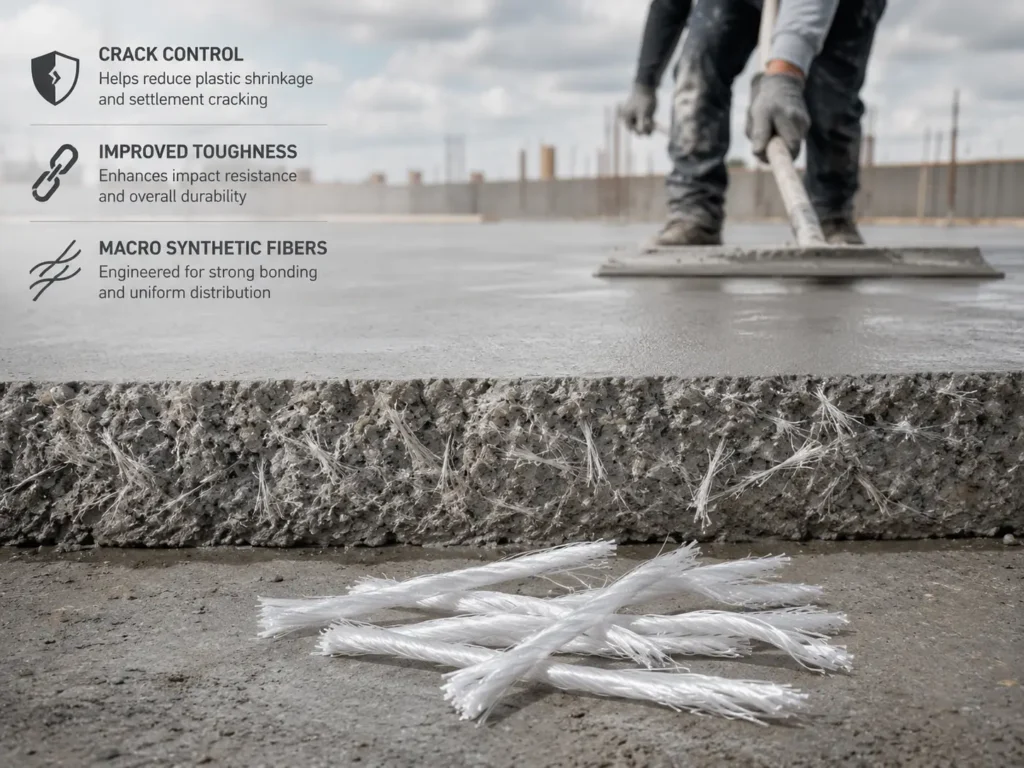
Hybrid fiber reinforced concrete can be used in many projects. The best value appears when the concrete needs crack control, toughness, and durability.
Industrial Slabs
Industrial slabs face shrinkage, forklift traffic, wheel loads, and impact. Fibers can help reduce visible cracking and improve load transfer at cracks. Macro synthetic fiber is often used where steel corrosion or surface rust spots are a concern. Steel fiber may be selected when high stiffness is required.
Béton projeté
Shotcrete needs fast placement, good build-up, and post-crack toughness. Fibers can reduce the need for some traditional mesh in certain designs. They can also support tunnel lining, slope stabilization, mining support, and repair work. The fiber must disperse well and pass through equipment without blocking.
Precast Concrete
Precast producers need stable quality, fast production, and clean demolding. Fibers can help control handling cracks, shrinkage cracks, and edge damage. The dosage must be balanced with surface finish and workability.
Repair Mortar And Overlays
Repair materials often face shrinkage stress and bonding stress. Microfibers can help control small cracks. Macro fibers can add toughness when the repair layer is thick enough. A hybrid system can be useful when the repair area has both early shrinkage risk and later service load.
Pavement And Infrastructure Concrete
Roads, airport slabs, bridge decks, and tunnel works need long-term crack control. A good fiber system can support durability by reducing crack width and improving impact resistance. This can help reduce maintenance pressure over time.
How To Choose The Right Fiber System
A buyer should not choose fiber only by price per kilogram. This is a common mistake. Fiber performance depends on dosage, shape, tensile strength, modulus, bonding, dispersion, and the final concrete application.
A lower-cost fiber may need a higher dosage. A stronger fiber may work at a lower dosage. A fiber with poor dispersion may create clumps. A fiber with the wrong geometry may not bridge cracks well. A fiber that works in mortar may not work in a high-volume concrete plant.
Here is a simple selection guide.
| Project Need | Recommended Fiber Direction | Reason |
|---|---|---|
| Contrôle des fissures de retrait plastique | Fibre de micro polypropylène | It spreads through paste and controls early microcracks |
| Post-crack toughness | Macro synthetic fiber or steel fiber | It bridges wider cracks after hardening |
| Corrosion-free reinforcement | Fibre synthétique macro | It does not rust in exposed concrete |
| High stiffness crack bridging | Fibre d'acier | It has high modulus and strong bridging force |
| Better multi-stage crack control | Hybrid micro + macro system | It works across different crack sizes |
| Shotcrete toughness | Steel fiber or macro synthetic fiber | It supports residual capacity after cracking |
The right dosage should be confirmed by trial mixing and testing. The concrete producer should check slump, air content, mixing time, pumpability, finishability, and hardened performance.
Why Dosage Balance Matters
More fiber does not always mean better concrete. A very high fiber dosage can make the mix hard to place. It can increase the risk of balling. It can reduce slump. It can also raise air content if the fiber surface and mixing process are not controlled.
The best dosage is the dosage that gives the required performance while keeping the mix workable.
This is why Ecocretefiber™ recommends project-based fiber selection. A tunnel shotcrete mix, an industrial floor mix, and a precast panel mix do not need the same fiber solution. Each mix has a different binder system, aggregate grading, admixture package, water-binder ratio, and placement method.
A good fiber supplier should ask about the project before giving a final recommendation. The supplier should understand the application, target performance, mixing process, and local standard requirements.
What Ecocretefiber™ Can Provide
Ecocretefiber™ is the concrete fiber brand of Shandong Jianbang Chemical Fiber Co, Ltd. We focus on practical fiber solutions for concrete and cement-based materials. Our product direction covers micro polypropylene fiber, macro synthetic fiber, steel fiber, and other concrete reinforcement fibers for different construction needs.
We support buyers who need stable supply, technical communication, OEM packaging, and product selection for different markets. We can help distributors build a clearer product line. We can also help contractors compare fiber choices for slabs, shotcrete, precast concrete, and repair materials.
Our position is simple. We do not want customers to choose fiber blindly. We want customers to choose the fiber that fits the project.
A good concrete fiber should be easy to mix. It should disperse evenly. It should match the concrete application. It should come with clear technical data. It should also have stable quality from batch to batch.
Practical Buyer Questions Before Ordering
Before ordering concrete fiber, buyers should prepare a few details.
What is the application? Is it a slab, shotcrete, precast part, repair mortar, or pavement?
What is the main target? Is it plastic shrinkage control, post-crack toughness, impact resistance, or replacement of some mesh under design approval?
What concrete grade and mix design will be used?
What mixing equipment will be used?
Does the project need ASTM C1609, EN 14889-2, or another local test reference?
What dosage range is acceptable for cost and workability?
These questions help avoid mistakes. They also help the supplier recommend a more useful fiber system.
Conclusion
Hybrid fiber reinforced concrete gives engineers and contractors a better way to manage cracking. It does not rely on one single fiber function. It uses different fiber types to control cracks at different stages.
Micro fibers help control early microcracks. Macro synthetic fibers and steel fibers help bridge larger cracks after hardening. A good hybrid system can improve toughness, crack distribution, and post-crack behavior. It can support better performance in slabs, shotcrete, precast concrete, repair concrete, and infrastructure work.
The key is not to add fiber without a plan. The key is to match fiber type, dosage, and concrete design with the real project need.
Shandong Jianbang Chemical Fiber Co, Ltd. supplies Ecocretefiber™ concrete fiber solutions for customers who need practical crack control and stable product quality. If your project needs polypropylene fiber, macro synthetic fiber, steel fiber, or a hybrid fiber solution, Ecocretefiber™ can help you compare options and choose a suitable product for your concrete mix.