Why Concrete Durability Needs More Attention
Concrete is one of the most widely used construction materials in the world. It is used in dams, bridges, tunnels, roads, buildings, industrial floors, precast components, and many other structures. It has good compressive strength. It is also easy to shape and widely available.
But ordinary concrete still has clear limits. It has poor toughness. It is weak in tension. It can crack under impact, shrinkage, bending, temperature change, and repeated load. It can also suffer from sulfate attack, chloride attack, freeze-thaw damage, high temperature damage, and long-term water erosion.
Once cracks appear, durability problems become more serious. Water can enter the concrete. Salt can enter the concrete. Harmful ions can move through pores and cracks. Reinforcement may corrode. The structure may lose strength and service life.
This is why fiber reinforced concrete is becoming more important. Fiber can help control cracks. It can improve toughness. It can improve impact resistance. It can also help concrete keep better performance in harsh environments.
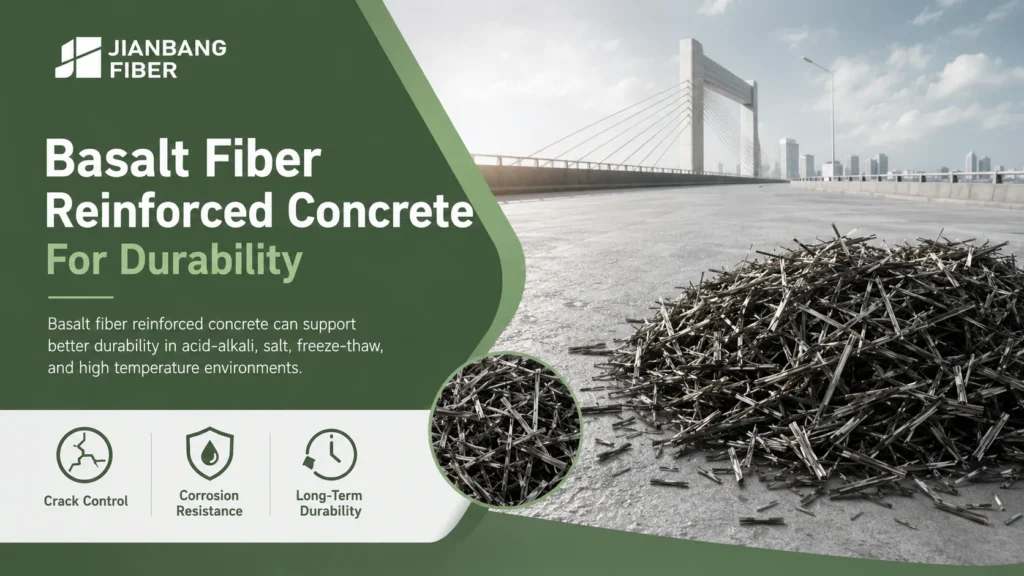
Shandong Jianbang finds out that basalt fiber reinforced concrete is a useful direction for durable infrastructure concrete. Basalt fiber has good strength, high elastic modulus, high temperature resistance, freeze-thaw resistance, corrosion resistance, and environmental advantages. When it is used correctly, it can help improve the durability of concrete in road, bridge, tunnel, marine, hydraulic, and industrial projects.
At Shandong Jianbang Chemical Fiber Co., Ltd., our concrete fiber brand Ecocretefiber™ supplies fiber solutions for concrete crack control and durability improvement. Our product direction includes basalt fiber, polypropylene fiber, macro synthetic fiber, steel fiber, PVA fiber, and other concrete reinforcement fibers.
What Is Basalt Fiber Reinforced Concrete?
Basalt fiber reinforced concrete, often called BFRC, is concrete mixed with short basalt fibers. Basalt fiber is made from natural basalt rock through melting and fiber-forming processes. It is a mineral fiber, not an organic polymer fiber.
Basalt fiber has several useful properties for concrete. It has high tensile strength. It has good elastic modulus. It can resist high temperature better than many synthetic fibers. It also has good chemical stability in many environments.
Another important point is density. Basalt fiber has a density close to the concrete matrix. This can help it work better inside concrete compared with fibers that are much lighter or much heavier. When the mix design is suitable, basalt fiber can be wrapped by cement paste and distributed through the concrete.
Shandong Jianbang finds out that basalt fiber works mainly by improving crack resistance and internal structure. It can bridge small cracks. It can slow crack growth. It can reduce harmful pore connection. It can also improve the concrete’s ability to resist corrosion and environmental damage.
This does not mean basalt fiber should be added without control. Fiber type, length, dosage, mixing method, water-binder ratio, aggregate grading, and curing all affect the final result.
Why Basalt Fiber Is Called A Green Fiber Material
Basalt fiber is made from basalt rock. It does not need many complex raw materials. It is often viewed as an environmentally friendly mineral fiber because the raw material is widely available and the production process can be cleaner than some traditional fiber materials.
Shandong Jianbang finds out that basalt fiber has value in sustainable construction because it can improve concrete durability. A more durable concrete structure can last longer. Longer service life can reduce repair frequency, replacement material, transportation cost, and maintenance shutdowns.
For infrastructure, this matters. A road, bridge, tunnel, or dam is not only built once. It must serve for many years. If concrete cracks too early, the project owner must spend more money on repair. If the structure is in a harsh environment, poor durability can become a serious safety risk.
Basalt fiber can help reduce this risk when it is designed into the concrete system correctly.
Acid And Alkali Resistance Of Basalt Fiber Concrete
Many concrete structures work in aggressive chemical environments. These include sulfate soil, chloride-rich groundwater, industrial wastewater, salt lake areas, marine environments, and alkaline environments.
Ordinary concrete can be damaged by these conditions. Sulfate attack can change hydration products and create internal expansion. Chloride can enter concrete and increase reinforcement corrosion risk. Alkali and salt movement can also change internal pore structure.
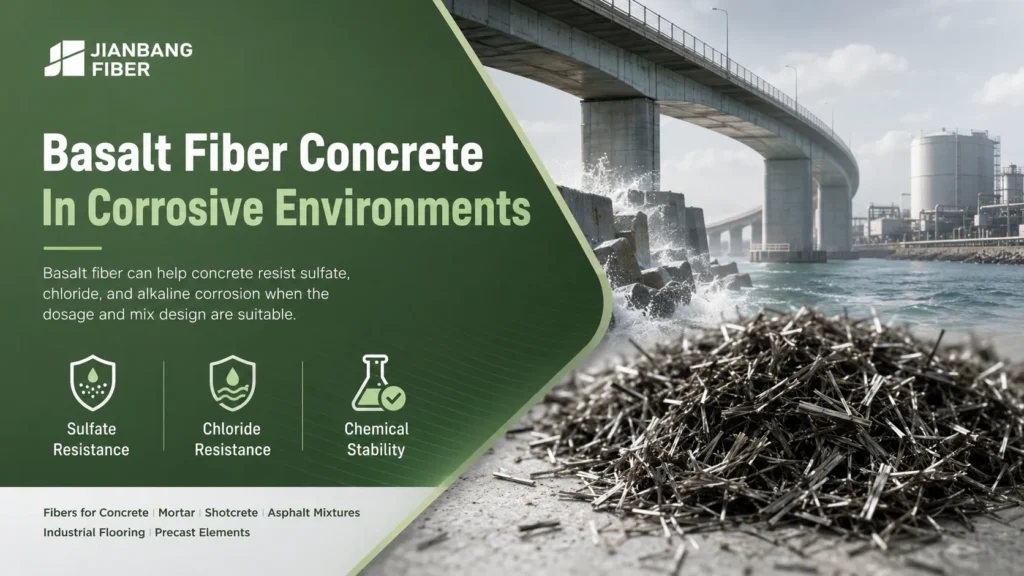
Shandong Jianbang finds out that basalt fiber can improve concrete corrosion resistance in acid-alkali and salt environments. In sulfate and sulfate-chloride environments, basalt fiber reinforced concrete can show better resistance than ordinary concrete when the fiber dosage is suitable.
Basalt fiber helps in several ways. It can bridge cracks and slow crack development. It can improve the internal pore structure. It can reduce connected pores. It can also improve the concrete’s ability to resist ion migration.
In alkaline environments, basalt fiber can help control crack formation and crack growth. It can also reduce the migration of sodium ions inside concrete. This supports better corrosion resistance and longer service life.
Sulfate And Chloride Attack
Sulfate and chloride attack are common durability problems. They are especially important in marine concrete, underground structures, salt lake regions, and deicing salt environments.
Shandong Jianbang finds out that basalt fiber concrete can perform well under sulfate-chloride combined attack. In some research results, the concrete under sulfate-chloride combined solution showed better performance than under sulfate solution alone. This may be because chloride can change the corrosion process and reduce some sulfate-related damage effects in certain conditions.
However, this does not mean chloride is harmless. Chloride is still a major risk for reinforced concrete because it can lead to steel corrosion. The point is that chemical attack is complex. The real performance depends on ion concentration, exposure time, concrete density, fiber dosage, water-binder ratio, and curing condition.
For buyers, the key lesson is practical. If the project is in sulfate soil, marine exposure, salt lake area, or deicing salt environment, the concrete should be designed as a full durability system. Basalt fiber can help, but it should work together with low permeability concrete, proper cementitious materials, correct curing, and good crack control.
Basalt Fiber And Concrete Impermeability
Impermeability is very important for durability. If water and harmful ions cannot easily enter the concrete, corrosion and freeze-thaw damage can be reduced.
Shandong Jianbang finds out that basalt fiber can improve concrete impermeability when the dosage is suitable. The fiber helps reduce crack growth and improve internal structure. It can also reduce the connection between pores.
Some studies show that basalt fiber and polypropylene fiber hybrid systems can improve the gas permeability resistance of concrete. This means the concrete becomes less open to harmful fluid or gas movement. For real projects, lower permeability usually means better durability.
But fiber dosage must be controlled. Too much basalt fiber can create problems. If there is not enough cement paste to wrap the fibers, the mixture can lose density. Fiber clumps may appear. Micro cracks and air voids may increase. This can reduce impermeability and corrosion resistance.
This is why Shandong Jianbang does not recommend adding fiber blindly. The right dosage should be confirmed by trial mixing and testing.
Why More Basalt Fiber Is Not Always Better
A common mistake is to think that more fiber always means better concrete. This is not true.
Shandong Jianbang finds out that basalt fiber has an optimum dosage range. Below that range, the fiber network may not be strong enough to control cracks. Above that range, the concrete may lose workability and density.
When too much fiber is added, the cement paste may not fully cover every fiber. The fibers may clump. The mixture may become harder to mix and place. The internal structure may become less compact. Air voids and micro cracks may increase. This can reduce durability.
Different performance targets may need different optimum dosages. Some research shows that about 0.3% basalt fiber may give good sulfate resistance and impermeability. Other results suggest that around 1.0% may perform well for mechanical performance under salt corrosion. These values are not universal. They depend on fiber length, fiber diameter, concrete strength grade, mix design, exposure environment, and testing method.
For construction buyers, the best approach is simple. Choose a reasonable dosage range first. Then run a trial mix. Check workability, strength, crack resistance, permeability, and durability index. Do not choose dosage only by marketing claims.
High Temperature Resistance Of Basalt Fiber Concrete
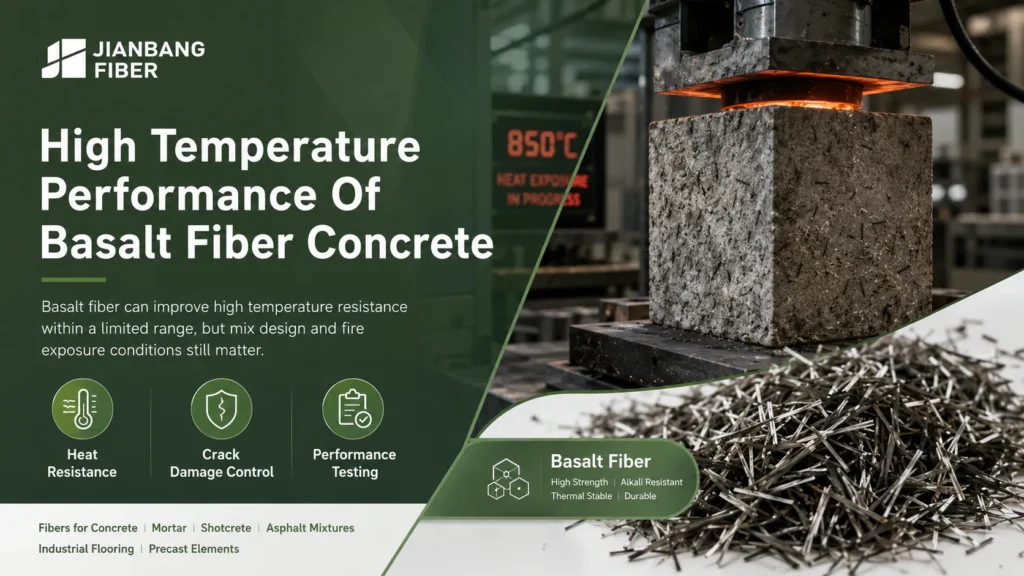
High temperature can seriously damage concrete. Fire exposure can cause water evaporation, pore pressure increase, cracking, strength loss, and surface spalling. For tunnels, industrial buildings, power plants, underground structures, and transportation projects, high temperature performance is an important safety factor.
Basalt fiber has good high temperature resistance. This makes it useful in concrete exposed to heat or fire risk.
Shandong Jianbang finds out that basalt fiber can improve concrete high temperature resistance within a certain range. It can improve dynamic compressive strength and impact toughness after high temperature exposure. It can also reduce the damage deterioration degree of concrete after heating.
However, basalt fiber cannot completely solve explosive spalling. High temperature damage is controlled by many factors. These include concrete density, moisture content, heating rate, pore pressure, aggregate type, fiber type, fiber dosage, and structure thickness.
This is why basalt fiber should be viewed as part of a high temperature performance system, not a single magic solution.
What Happens To Basalt Fiber Concrete At Different Temperatures?
Shandong Jianbang finds out that the appearance and performance of basalt fiber concrete change as temperature rises.
At around 200°C, the concrete surface may still show no obvious cracks. At around 400°C, micro cracks may start to appear. At around 600°C, cracks increase, and slight spalling may occur at corners. At around 800°C, surface cracks become more serious, and the outer skin may begin to peel.
The internal mechanism also changes with temperature. At 150°C to 200°C, free water inside concrete evaporates. Part of the combined water in C-S-H gel is removed. This can make the gel structure temporarily denser. The concrete strength may increase slightly in this range.
When the temperature continues to rise, the original balance is broken. Hydration products decompose. Internal pores grow. Cracks expand. The concrete structure becomes damaged.
This explains why high temperature performance is not linear. A moderate temperature may cause a small strength increase, while higher temperature can cause serious damage.
Basalt Fiber And Freeze-Thaw Resistance
Freeze-thaw damage is another major durability issue. In cold regions, water enters concrete pores and cracks. When water freezes, it expands. Repeated freezing and thawing creates internal pressure. This can cause scaling, cracking, mass loss, and strength reduction.
Basalt fiber can help concrete resist freeze-thaw damage. It can control cracks and improve toughness. It can also help reduce damage development during repeated cycles.
Shandong Jianbang finds out that basalt fiber concrete has better freeze-thaw durability than ordinary concrete when the fiber dosage and curing condition are suitable. This makes it useful for roads, bridges, airport pavements, hydraulic structures, and cold-region infrastructure.
But freeze-thaw resistance does not depend on fiber alone. Air-entrainment, water-binder ratio, curing, aggregate quality, and concrete density are also important. A good freeze-thaw resistant concrete must be designed as a system.
For cold-region projects, basalt fiber can be combined with proper air-entraining admixture, dense matrix design, and good curing to improve long-term performance.
Multi-Factor Durability Is The Real Engineering Problem
Many laboratory studies test one factor at a time. For example, one test may study sulfate attack. Another test may study high temperature. Another test may study freeze-thaw cycles.
This is useful for understanding material behavior. But real engineering environments are more complex.
A tunnel may face groundwater, chloride, sulfate, freeze-thaw, and fire risk. A bridge deck may face traffic load, deicing salt, freeze-thaw cycles, and impact. A coastal structure may face chloride, wet-dry cycles, temperature changes, and mechanical load.
Shandong Jianbang finds out that future basalt fiber concrete evaluation should focus more on multi-factor coupling. This means studying how basalt fiber concrete performs when several damage sources act together.
For buyers, this means the application environment must be described clearly before choosing fiber. A supplier cannot give the best recommendation without knowing whether the project faces salt attack, freeze-thaw cycles, high temperature, heavy load, or chemical corrosion.
Practical Applications Of Basalt Fiber Concrete
Basalt fiber concrete can be used in many infrastructure applications.
In road concrete, basalt fiber can improve crack control, impact resistance, and freeze-thaw durability. This is useful for cold regions and heavy traffic areas.
In bridge concrete, basalt fiber can support crack control and durability in decks, repair layers, and protective concrete.
In tunnel lining, basalt fiber can improve toughness and durability under groundwater, chemical exposure, and possible fire conditions.
In hydraulic structures, basalt fiber can help resist water erosion, sulfate attack, and cracking.
In precast products, basalt fiber can reduce handling cracks and improve durability.
In industrial floors, basalt fiber can help improve crack control and wear performance, especially where non-metallic reinforcement is preferred.
Shandong Jianbang finds out that basalt fiber is especially attractive when a project needs corrosion resistance, high temperature resistance, and environmentally friendly material direction.
Basalt Fiber Compared With Other Concrete Fibers
Basalt fiber is one type of concrete fiber. It should be selected based on project needs.
| Fiber Type | Main Strength | Typical Use |
|---|---|---|
| Basalt fiber | Corrosion resistance, high temperature resistance, crack control | Roads, bridges, tunnels, hydraulic concrete, precast products |
| Steel fiber | High stiffness and strong post-crack bridging | Industrial floors, shotcrete, tunnel lining, heavy-duty slabs |
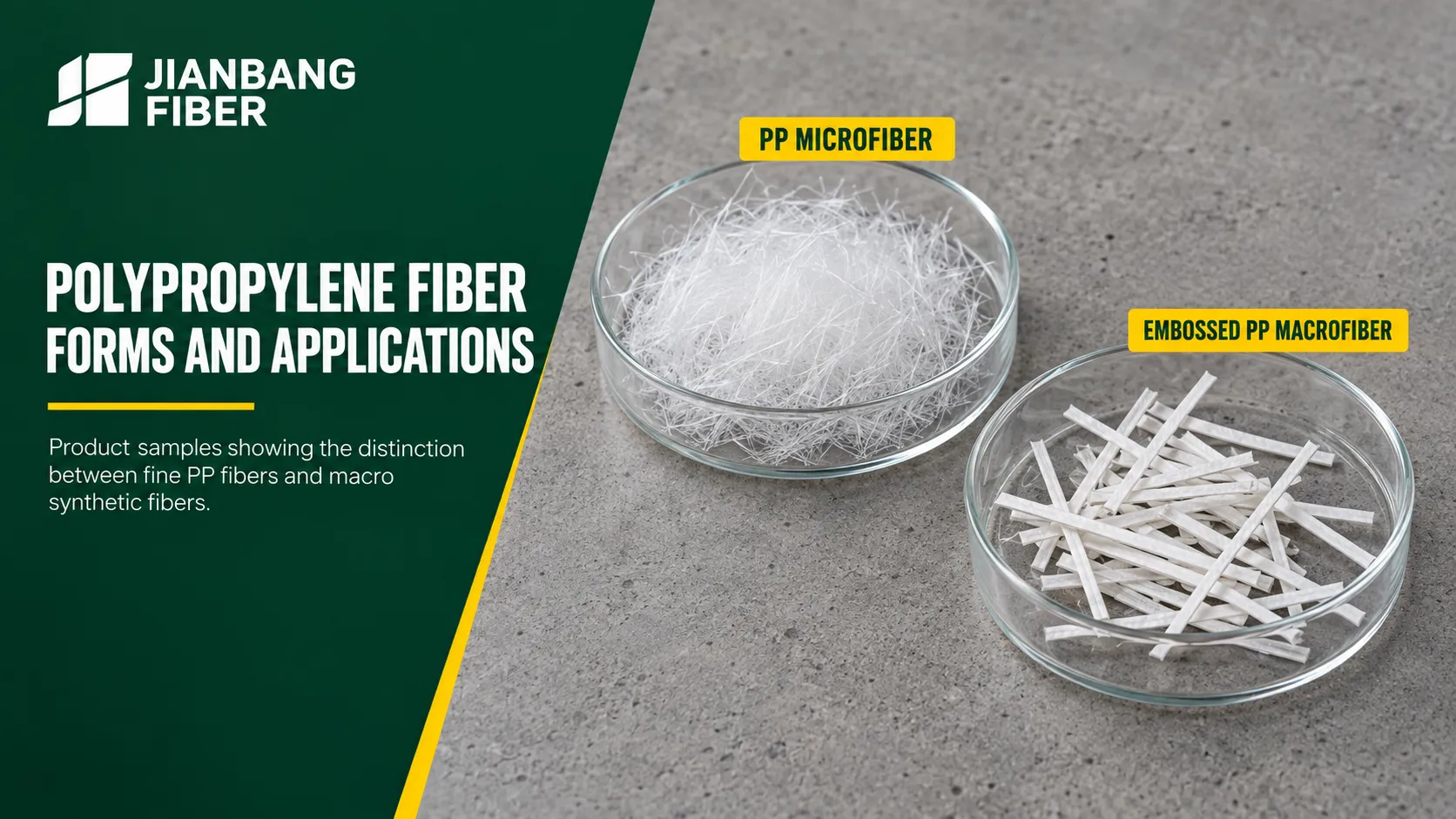
| Polypropylene micro fiber | Plastic shrinkage crack control | Mortar, plaster, slabs, pavement |
| Macro synthetic fiber | Corrosion-free toughness | Slabs, shotcrete, precast concrete, road and bridge work |
| PVA fiber | Strong cement matrix bonding and ductility | ECC, repair mortar, high-toughness cement composites |
Basalt fiber can be a good option when the project needs durability and non-metallic reinforcement. Steel fiber may be better when high residual load capacity is the main goal. PP fiber may be better for plastic shrinkage control. Macro synthetic fiber may be better for corrosion-free post-crack toughness.
The best solution depends on project environment and performance target.
Mix Design Tips For Basalt Fiber Concrete
Basalt fiber concrete needs careful mix design. The fiber should disperse evenly. The concrete should remain workable. The matrix should be dense. The cement paste should be enough to coat the fiber and aggregate.
The first point is fiber dosage. The dosage should match the performance target. Too little fiber may not control cracks well. Too much fiber can reduce density and workability.
The second point is fiber length. Longer fiber may bridge cracks better, but it may be harder to disperse. Shorter fiber may disperse better, but it may have weaker bridging effect.
The third point is water-binder ratio. A lower water-binder ratio can improve durability, but it may reduce workability. Water reducer may be needed.
The fourth point is aggregate grading. Good grading improves density and reduces voids. It also helps fiber dispersion.
The fifth point is mixing method. Fiber should be added evenly. It should not be dumped too fast. Mixing should prevent clumping.
The sixth point is curing. Good curing supports hydration, reduces shrinkage, and improves durability.
Safe Handling And Construction Notes
Basalt fiber is a mineral fiber. During handling, dry fiber dust or small fibers may irritate skin, eyes, or the respiratory tract. Workers should use basic protection.
Gloves can help avoid skin irritation. Safety glasses can protect eyes. A dust mask can reduce inhalation of airborne fibers. The mixing area should be ventilated. Bags should be opened carefully.
The fiber should be stored in a dry place. Moisture can affect feeding and dispersion. Packaging should remain sealed before use.
During mixing, the fiber should be added slowly and evenly. This reduces floating fiber and clumping. The concrete should be checked for workability, fiber balling, and uniformity before placement.
A trial mix is recommended before large-scale construction.
Why Choose Ecocretefiber™ Basalt Fiber Solutions
Ecocretefiber™ is the concrete fiber brand of Shandong Jianbang Chemical Fiber Co., Ltd. We supply concrete fiber solutions for road pavement, bridge deck, tunnel lining, hydraulic concrete, industrial floors, shotcrete, precast concrete, and repair mortar.
Our product direction includes basalt fiber, steel fiber, polypropylene fiber, macro synthetic fiber, PVA fiber, and other concrete reinforcement fibers. We help customers compare fiber choices based on crack type, exposure environment, concrete grade, construction method, and durability target.
For basalt fiber concrete, we focus on corrosion resistance, high temperature performance, freeze-thaw durability, crack control, and practical mix design. We understand that fiber selection should not be based on one simple parameter. It should be based on real engineering conditions.
Ecocretefiber™ can support contractors, distributors, ready-mix plants, precast factories, and infrastructure project teams with product selection, packaging options, OEM service, and technical communication.
Buyer Checklist Before Ordering Basalt Fiber For Concrete
Before ordering basalt fiber, buyers should prepare several details.
| Question | Why It Matters |
|---|---|
| What is the project application? | Road, bridge, tunnel, hydraulic structure, and precast concrete need different designs. |
| What is the exposure environment? | Sulfate, chloride, freeze-thaw, heat, and alkali exposure affect fiber selection. |
| What concrete grade is required? | Matrix strength affects fiber performance. |
| What is the target fiber dosage? | Dosage affects crack control, workability, and density. |
| What fiber length is needed? | Length affects dispersion and bridging effect. |
| Is high temperature resistance required? | Basalt fiber can help, but fire performance needs full-system design. |
| Is freeze-thaw durability required? | Fiber should work with air-entrainment and dense concrete design. |
| What mixing equipment will be used? | Mixer type affects fiber dispersion and balling risk. |
| Is a trial mix planned? | Trial mixing reduces construction risk. |
This checklist helps buyers choose a suitable fiber solution and avoid common mistakes.
Conclusion
Basalt fiber reinforced concrete is a practical durability solution for modern infrastructure. It can improve crack control, corrosion resistance, high temperature performance, freeze-thaw durability, and toughness when the dosage and mix design are correct.
Shandong Jianbang finds out that basalt fiber performs well in acid-alkali, sulfate, chloride, high temperature, and freeze-thaw related environments. But Shandong Jianbang also finds out that more fiber is not always better. Excessive fiber dosage can reduce concrete density, create fiber clumps, increase pores, and weaken durability.
The right approach is to design basalt fiber concrete as a full system. Fiber type, fiber length, dosage, water-binder ratio, aggregate grading, admixture, mixing method, curing, and exposure condition must work together.
Shandong Jianbang Chemical Fiber Co., Ltd. supplies Ecocretefiber™ concrete fiber solutions for customers who need better durability, better crack control, and more reliable infrastructure concrete. If your project needs basalt fiber, steel fiber, polypropylene fiber, macro synthetic fiber, or PVA fiber, Ecocretefiber™ can help you select a suitable fiber solution for your concrete system.