Why Road Concrete Needs Fiber Reinforcement
Road concrete works under repeated stress every day. It carries vehicle loads, wheel impact, temperature change, freeze-thaw cycles, moisture, and surface wear. Ordinary concrete has good compressive strength, but it is still a brittle material. Once cracks appear, water and harmful ions can enter the pavement. This can reduce road service life and increase repair cost.
This is why fiber reinforcement is useful in road concrete. Fibers can form a distributed reinforcement network inside the cement matrix. They help control crack growth. They can improve bending behavior. They can also improve impact resistance and durability when the mix design is correct.
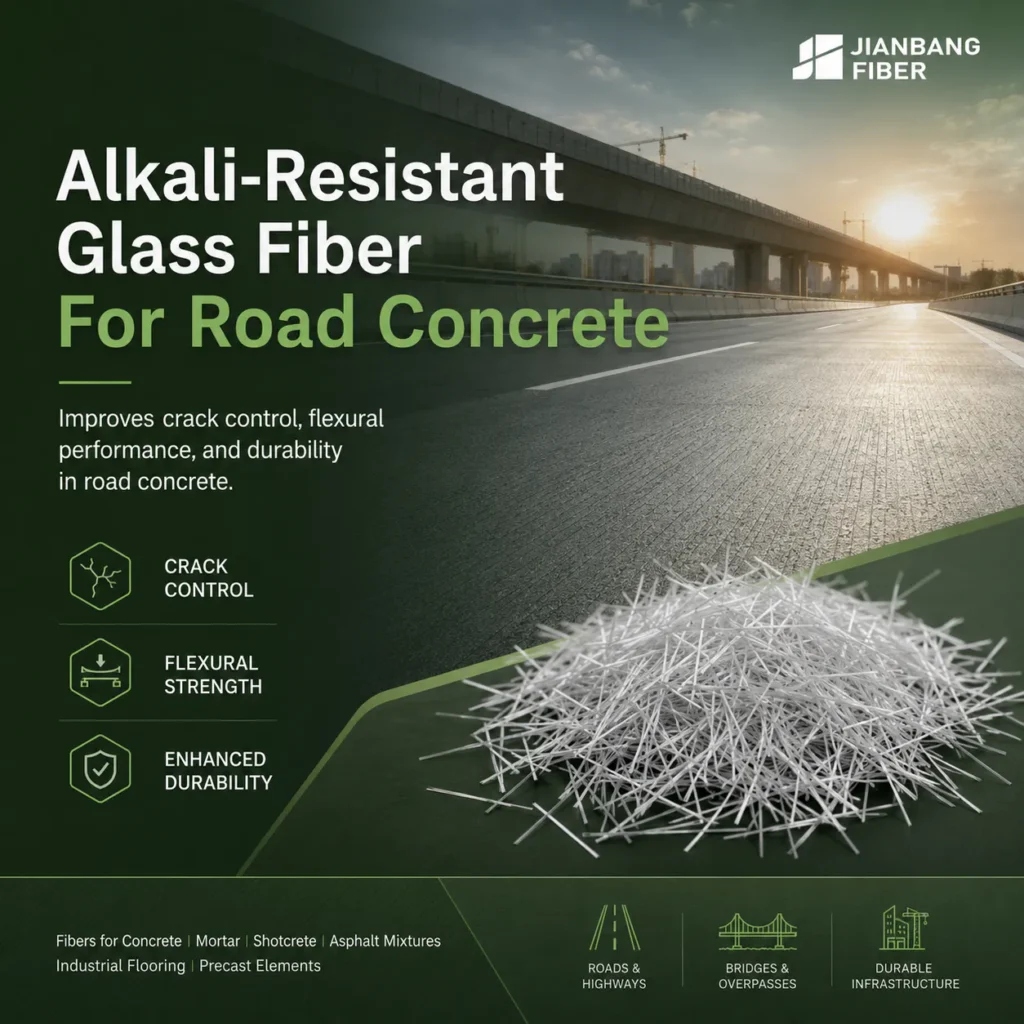
Shandong Jianbang finds out that alkali-resistant glass fiber can be used as a reinforcing material in road concrete. It can help improve tensile and flexural behavior, freeze-crack resistance, impact resistance, and corrosion resistance. These benefits make it useful for pavement concrete, road repair concrete, and other infrastructure concrete applications.
At Shandong Jianbang Chemical Fiber Co., Ltd., our concrete fiber brand Ecocretefiber™ focuses on practical concrete reinforcement fiber solutions. Our goal is not only to sell fiber. Our goal is to help customers choose a fiber system that matches the concrete mix, road environment, construction method, and service life target.
What Is Alkali-Resistant Glass Fiber?
Alkali-resistant glass fiber, often called AR glass fiber, is a glass fiber designed for cement-based materials. Cement paste is alkaline. Normal glass fiber can lose strength in this alkaline environment. AR glass fiber is made to resist alkali attack better than ordinary glass fiber.
In road concrete, AR glass fiber can be used to improve crack control and flexural performance. It works as a small reinforcing rib inside the concrete. When the concrete starts to form micro cracks, the fibers help bridge those cracks and slow their development.
This does not mean AR glass fiber can replace every type of reinforcement. It should be used for the right purpose. It is more suitable for crack control, flexural support, shrinkage reduction, and surface durability improvement. For heavy structural post-crack performance, steel fiber or macro synthetic fiber may still be needed depending on design requirements.
Shandong Jianbang finds out that road concrete fiber selection should be based on environment, expected crack type, mix design, curing condition, and construction process.
Main Benefits Of AR Glass Fiber In Road Concrete
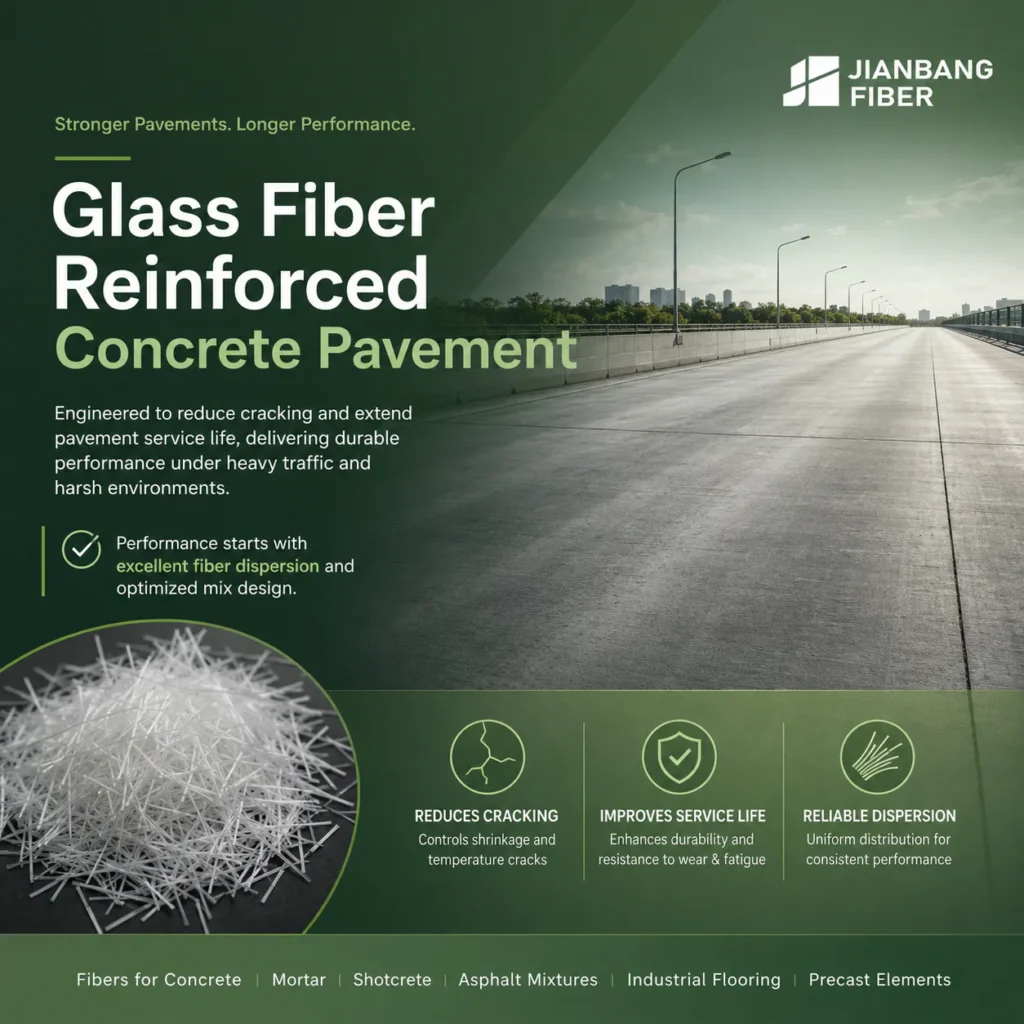
AR glass fiber can bring several benefits to road concrete when it is used correctly.
The first benefit is better crack control. Road concrete often cracks because of shrinkage, temperature change, drying, and repeated load. Fibers help distribute stress and reduce crack growth.
The second benefit is better flexural behavior. Road slabs are often affected by bending stress. A fiber network can help resist bending cracks and improve the pavement’s ability to keep integrity under load.
The third benefit is better freeze-crack resistance. In cold regions, water can enter pores and cracks. When water freezes, it expands and creates pressure. Fiber reinforcement can help limit crack development and reduce damage risk.
The fourth benefit is better impact resistance. Road concrete faces wheel impact and vibration. Fibers can help absorb part of the energy and reduce brittle damage.
The fifth benefit is corrosion resistance. AR glass fiber does not rust like steel. This can be useful in wet or chemically active road environments. But AR glass fiber still faces durability challenges in the alkaline cement matrix, so the mix design must reduce corrosion risk as much as possible.
The Key Problem: Alkali Attack
Even though AR glass fiber has better alkali resistance than ordinary glass fiber, it still works inside a cement system. Cement hydration creates an alkaline environment. This environment can attack glass fiber over time.
Shandong Jianbang finds out that when AR glass fiber is placed in a cement-based alkaline environment, corrosion may reduce fiber tensile strength and load-bearing ability. As corrosion becomes stronger, the fiber and surrounding mortar may develop more capillary pores. This can reduce flexural strength and durability.
This is an important point for buyers. AR glass fiber should not be selected only because its name says “alkali-resistant.” A good road concrete design must also reduce the damage environment around the fiber.
This can be done through mix design, fly ash use, dense packing, proper curing, and uniform fiber dispersion.
Why Early Flexural Strength Can Change
Flexural strength is one of the most important values for road concrete. Road pavement does not only carry compression. It also faces bending stress. This is why flexural performance is more meaningful than compressive strength alone.
Shandong Jianbang finds out that AR glass fiber reinforced mortar can reach a high flexural strength at an early curing age. In the tested condition, the flexural strength reached a high point around 4 days. After that, the value may decline because the fiber itself starts to degrade in the alkaline environment.
This tells us one thing clearly. Early strength improvement does not always mean long-term durability is fully solved. A fiber may improve early cracking behavior, but its long-term performance still depends on corrosion resistance, matrix density, curing, and interface quality.
For road projects, this means AR glass fiber concrete should be designed for both early construction needs and long-term pavement performance.
Why Fly Ash Matters In AR Glass Fiber Concrete
Fly ash can play an important role in AR glass fiber road concrete. It can improve the microstructure of concrete. It can reduce the negative effect of early strength loss when the mix is designed correctly. It can also make the cement matrix denser.
Shandong Jianbang finds out that adding fly ash into road concrete can change the chemical and physical structure of the mix. The microstructure can become more compact. This helps control the corrosion of AR glass fiber. A denser matrix can reduce harmful solution movement inside the concrete. It can also reduce capillary pore formation.
However, fly ash can reduce early strength in some ordinary mix designs. This is why the mix should use a dense packing strategy. A dense packing design uses aggregate as the main skeleton. It reduces voids. It improves particle arrangement. It also helps the concrete reach better density.
In some road concrete designs, when the fly ash content is higher than 33%, the mix can still meet early strength needs if the particle system is well designed and curing is controlled. The key is not only the fly ash amount. The key is how fly ash works with cement, aggregate, fiber, water, and admixture.
Dense Packing Design For Road Concrete
Dense packing means that particles are arranged in a way that leaves fewer voids. In road concrete, this idea is useful because fewer voids can improve strength, reduce shrinkage, and improve durability.
Shandong Jianbang finds out that AR glass fiber concrete should use aggregate as the main skeleton. The total aggregate amount may need to be adjusted, but the ratio between aggregate and sand should remain stable. This helps keep the concrete structure balanced.
When cement paste volume and water-binder ratio are fixed, the quality of the paste can still change because of fly ash, fiber, and particle packing. Dense packing helps the concrete become physically compact. A compact concrete matrix is better for road durability.
For AR glass fiber concrete, this is very important. A compact matrix can reduce the movement of alkaline solution. This helps reduce fiber corrosion risk. It also lowers internal pore pressure and reduces shrinkage.
A good road concrete mix should not be too porous. It should not have too much bleeding. It should not segregate. It should allow the fibers to disperse evenly.
Fiber Dispersion And Shrinkage Reduction
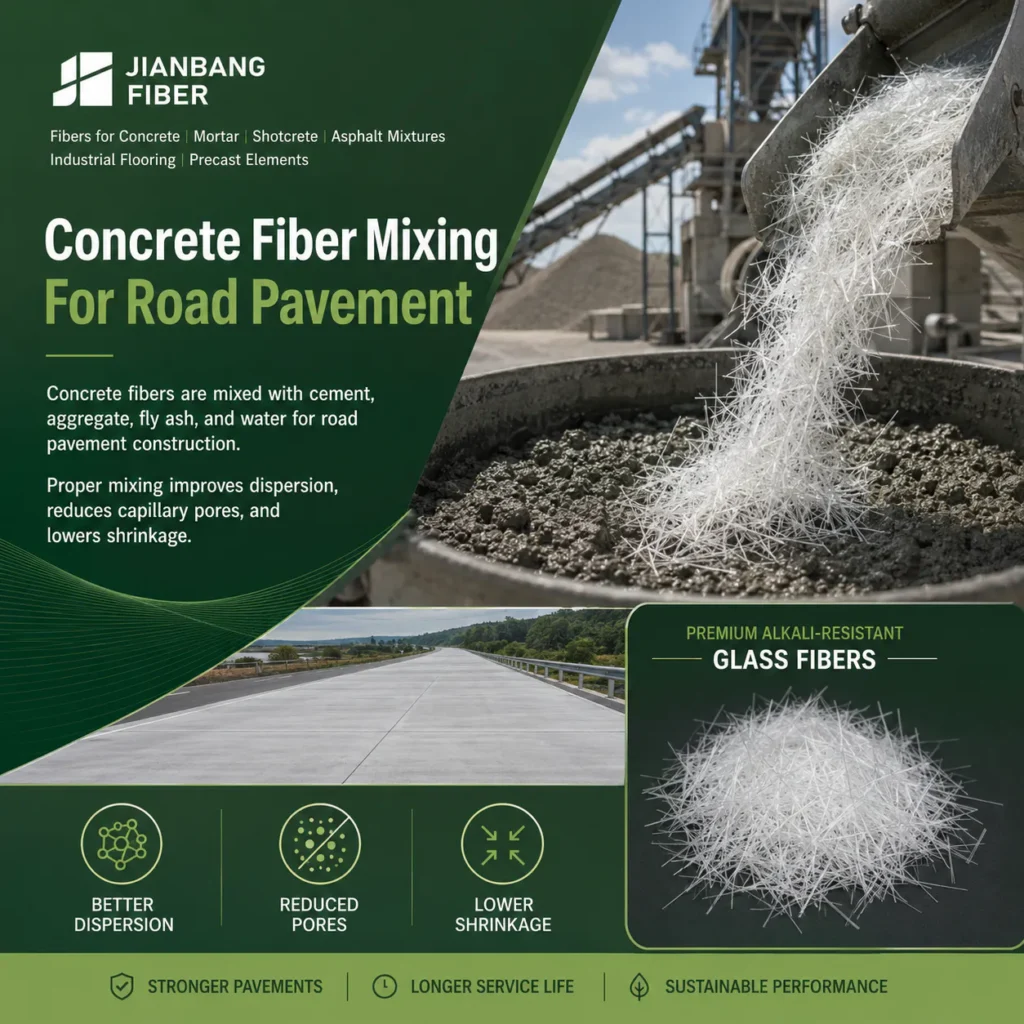
Fiber dispersion is one of the most important construction factors. If AR glass fibers are evenly distributed, they can reduce the number and size of capillary pores in the concrete. This helps reduce internal pressure. It also helps reduce shrinkage value.
Shandong Jianbang finds out that better fiber distribution can reduce shrinkage and lower road cracking risk. This is useful for road pavement because shrinkage cracks are a common problem. Once shrinkage cracks appear, traffic load and moisture can make them worse.
Uniform fiber dispersion depends on several things. The fiber length must be suitable. The dosage must be controlled. The mixing process must be correct. The concrete workability must be stable. The aggregate grading must not block fiber distribution.
If fibers clump, the concrete can develop weak points. Fiber clumps do not improve performance. They can reduce workability and create local defects. This is why mixing control is very important.
Standard Curing And Heat Curing
Curing affects road concrete performance. Poor curing can create shrinkage, surface cracks, low strength, and weak durability.
For standard curing, Shandong Jianbang finds out that specimens should be placed into water after demolding. The water temperature should be kept around 20°C. This stable curing environment helps cement hydration continue and helps concrete develop strength.
Heat curing can also be used for accelerated aging and durability prediction. In this method, the specimens are first cured under standard conditions, then slowly heated within a controlled time range. The temperature can be raised to around 80°C for constant-temperature curing until the test age is reached.
This method can accelerate aging. It can help predict alkali resistance and service life behavior. But heat curing should be used carefully. It is a testing or production control method, not a simple replacement for proper field curing.
In road construction, curing should protect the pavement from rapid drying, strong sun, wind, freezing, and early traffic load. Fiber can help crack control, but fiber cannot replace good curing.
How To Design AR Glass Fiber Road Concrete
A good AR glass fiber road concrete design should start with the project requirement. The mix should not be copied blindly from another project.
The first step is to define the application. Is it new pavement, repair overlay, airport pavement, industrial road, or municipal road? Different applications need different flexural strength and crack control.
The second step is to define the fiber function. Is the fiber used for early crack control, flexural performance, shrinkage reduction, or durability support?
The third step is to design the matrix. Cement, fly ash, aggregate, water-binder ratio, admixture, and sand ratio must work together. For AR glass fiber, a dense and stable matrix is important.
The fourth step is to control fiber dosage and dispersion. The fiber must be added in a way that prevents clumping. The mixing time should be enough for uniform distribution, but not so long that it damages workability.
The fifth step is to test the mix. The project should check workability, flexural strength, shrinkage, fiber dispersion, curing response, and durability.
AR Glass Fiber Compared With Steel Fiber And Synthetic Fiber
AR glass fiber is one option in the concrete fiber family. It should be compared with steel fiber and synthetic fiber based on the project need.
| Fiber Type | Main Value | Best Use Direction |
|---|---|---|
| AR glass fiber | Crack control and flexural support | Road concrete, thin concrete parts, cement-based products |
| Steel fiber | Strong crack bridging and toughness | Heavy-duty pavement, bridge deck, industrial floor, tunnel lining |
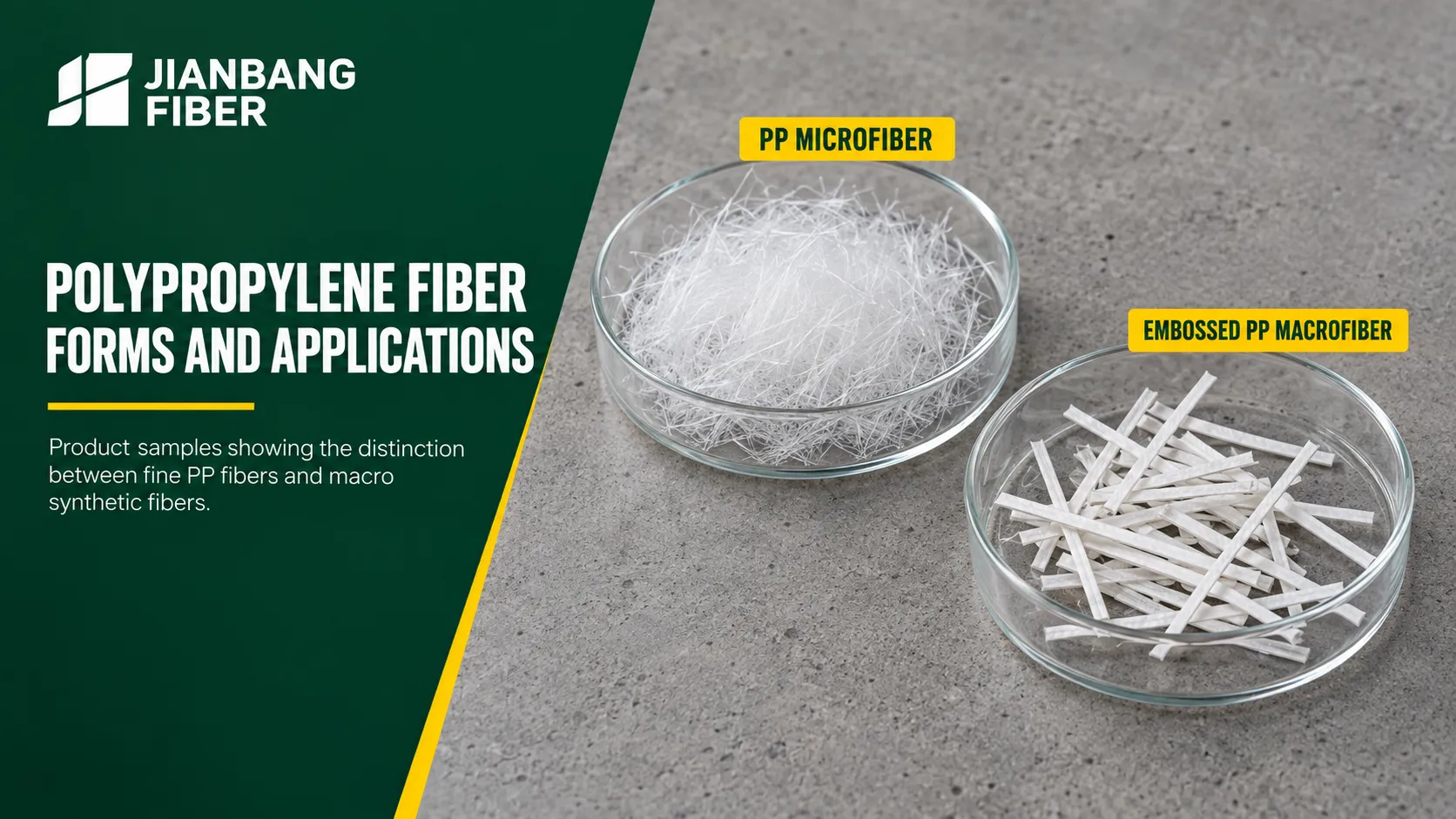
| Polypropylene micro fiber | Plastic shrinkage crack control | Pavement, mortar, plaster, precast concrete |
| Macro synthetic fiber | Corrosion-free post-crack toughness | Slabs, shotcrete, precast concrete, road and bridge work |
AR glass fiber is useful when the project needs non-rusting crack control and flexural support. Steel fiber is stronger for high post-crack toughness. Polypropylene micro fiber is better for plastic shrinkage crack control. Macro synthetic fiber can offer corrosion-free toughness for larger crack control.
Shandong Jianbang recommends choosing the fiber based on the real project condition, not only material name.
Practical Construction Tips
AR glass fiber concrete needs careful construction control. The first point is mixing order. Fiber should be added evenly and slowly. It should not be dumped into one position. The mixer must allow uniform dispersion.
The second point is workability. The mix should be workable enough for placing and finishing. If the mix is too dry, fibers may clump. If the mix is too wet, segregation may occur.
The third point is compaction. Road concrete must be compacted well. Poor compaction creates voids. Voids reduce strength and durability.
The fourth point is finishing. The pavement surface must be smooth and dense. Too much finishing water can weaken the surface. Poor finishing can create early defects.
The fifth point is curing. The pavement should be cured as soon as possible after finishing. Good curing reduces shrinkage and supports later strength development.
Why Choose Ecocretefiber™ For Road Concrete Fiber
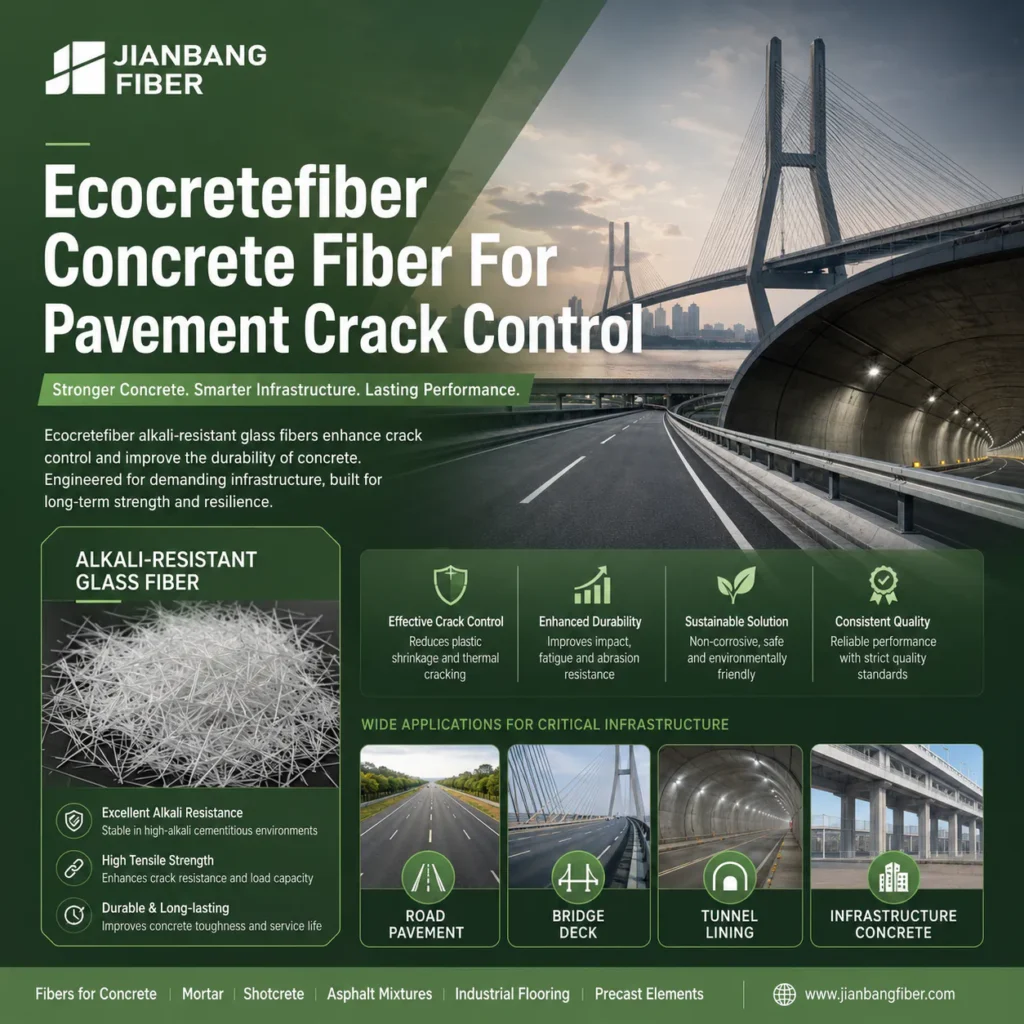
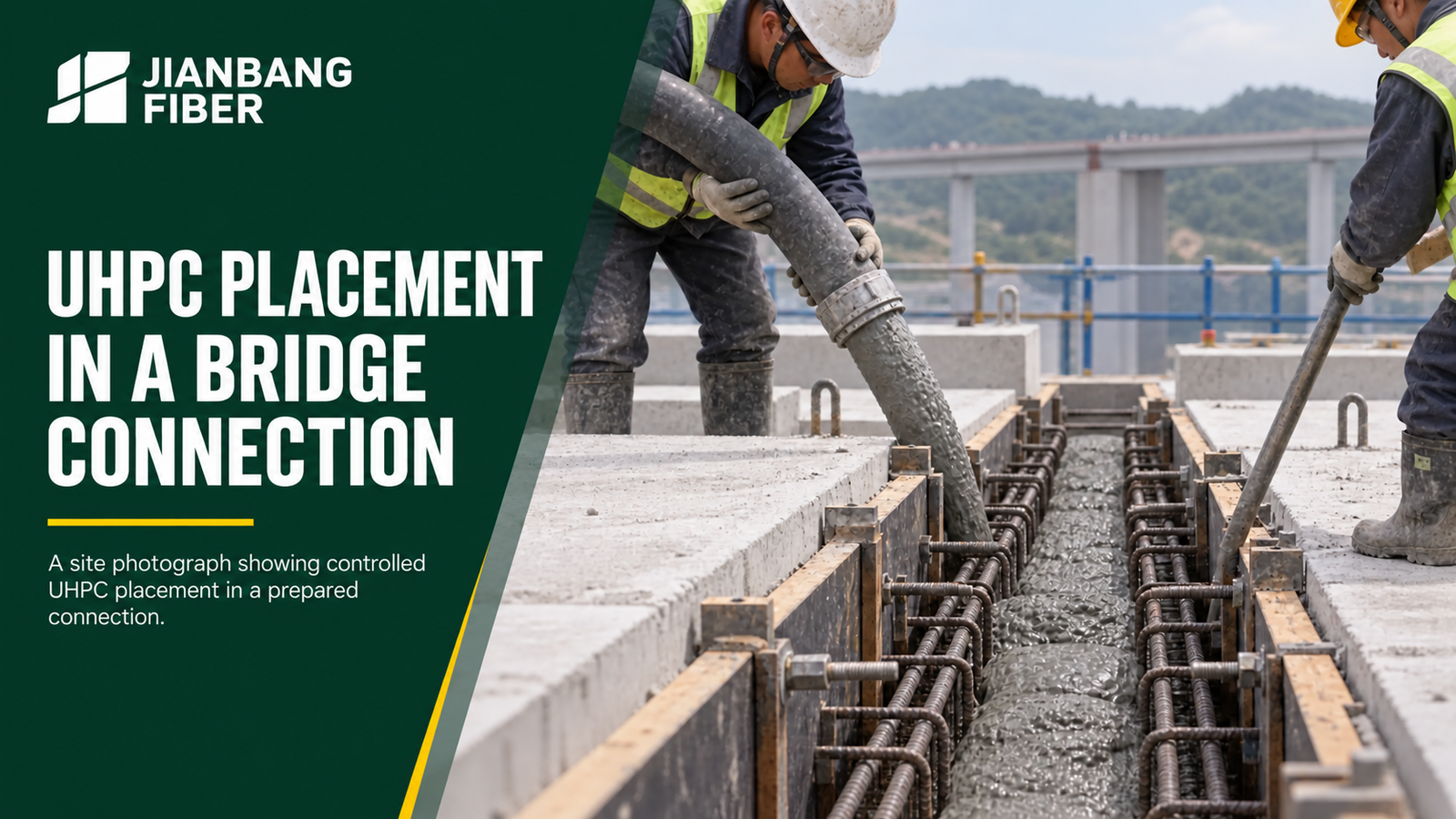
Ecocretefiber™ is the concrete fiber brand of Shandong Jianbang Chemical Fiber Co., Ltd. We supply concrete fiber solutions for road pavement, bridge deck, tunnel lining, shotcrete, precast concrete, industrial floors, and repair concrete.
Our product direction includes steel fiber, polypropylene fiber, macro synthetic fiber, and other concrete reinforcement fibers. We help customers choose fiber based on crack type, concrete design, construction method, environment, and target service life.
For road concrete projects, we understand that different fibers solve different problems. AR glass fiber can support crack control and flexural performance. Steel fiber can support heavy-duty toughness. PP fiber can help with micro crack control. Macro synthetic fiber can provide corrosion-free crack bridging.
Ecocretefiber™ can support distributors, contractors, ready-mix plants, and project owners with fiber selection, packaging options, OEM service, and application communication.
Buyer Checklist Before Ordering Concrete Fiber
Before ordering fiber for road concrete, buyers should confirm several details.
| Question | Why It Matters |
|---|---|
| What type of road project is it? | New pavement, repair, overlay, and airport pavement need different fiber systems. |
| What is the main problem? | Crack control, flexural strength, shrinkage, and durability need different solutions. |
| Is alkali resistance required? | Cement-based systems are alkaline, so fiber durability matters. |
| Is corrosion resistance important? | Non-metal fibers may be useful in wet environments. |
| What is the concrete grade? | Matrix strength affects fiber performance. |
| Will fly ash be used? | Fly ash can improve matrix density and help reduce corrosion risk. |
| What curing method will be used? | Curing affects strength, shrinkage, and durability. |
| How will the fiber be mixed? | Poor mixing can create fiber clumps and weak zones. |
This checklist helps reduce wrong product selection and construction risk.
Conclusion
Alkali-resistant glass fiber can be useful in road concrete when the mix design and construction process are properly controlled. It can improve crack control, flexural behavior, impact resistance, freeze-crack resistance, and durability support.
Shandong Jianbang finds out that AR glass fiber still faces corrosion risk in the alkaline cement matrix. This means the concrete system must be designed carefully. Fly ash, dense packing, proper curing, and uniform fiber dispersion are important. A dense microstructure can reduce capillary pores, lower shrinkage, and reduce road cracking risk.
Fiber is not a simple additive. It is part of the whole concrete system. The right performance comes from the right fiber type, dosage, mix design, mixing process, curing method, and construction control.
Shandong Jianbang Chemical Fiber Co., Ltd. supplies Ecocretefiber™ concrete fiber solutions for road pavement, bridge deck, tunnel lining, shotcrete, precast concrete, and infrastructure projects. If your road concrete project needs better crack control, better durability, or a practical fiber selection plan, Ecocretefiber™ can help you choose a suitable concrete fiber solution.